Air Quality Monitoring Stations discovered to be collecting biodiversity data

An international team of researchers has discovered that thousands of ambient air quality monitoring stations around the world are doing more than recording just atmospheric pollutants and dust, they are also likely collecting biodiversity data in the form of environmental DNA (eDNA). Until now it was thought that worldwide biodiversity monitoring simply didn’t exist

Until now, no one had considered that these air quality monitoring stations could be collecting and storing eDNA data on birds, bees, ticks, fungi, insects, plants and mammals across the globe as a byproduct of their regular function. But it is exactly what’s needed to monitor biodiversity at a scale that’s never been possible before and could also to potentially tap into the decades of historic eDNA biodiversity data on filters squirrelled away for years.

The discovery came about when researchers, including Joanne Littlefair and York University Assistant Professor Elizabeth Clare, proved that the presence of individual species can be detected by eDNA in the air. That would have been the end of the story, had Dr James Allerton and Dr Andrew Brown, two scientists at the UK’s National Physical Laboratory (NTL) not seen that research. 

Allerton said: ‘We were routinely collecting particulate matter looking to measure pollutants in air but when we saw the work, we realised maybe we were sitting on something much more valuable.’

After contacting Littlefair and Clare to ask if it was possible their monitors were collecting this information, an experiment was devised. 

An air quality station was set up in a large London park, collecting samples for an hour, a day and a week, and these were compared to eight-month-old samples from a public station in Scotland.

At Queen Mary University of London, Littlefair handled the samples, while Clare and grad student Nina Garrett analysed the data at York.

Elizabeth Clare: ‘We were surprised by the diversity of life we were able to survey with one approach, almost unheard in this field of science. In these two locations, we simultaneously detected the eDNA of 34 bird and 24 mammal species, a wide variety of insects, crops, pathogenic fungus, lovely wildflowers, ornamental garden plants and grasses.

‘We found species of interest, such as hedgehogs, along with badgers, deer, dormice, little owls, smooth newts, songbirds and 80 different kinds of woodland trees and plants – oak, linden, ash, pine – it was all there collected on these tiny filters. It’s unbelievably exciting.’

Dr Andrew Brown: ‘The beauty of the idea is we are making use of something that already exists. If networks of air samplers around the world are all collecting similar material – just as a part of their regular functioning – it’s an incredible resource.’

‘The potential of this cannot be overstated. It could be an absolute gamechanger for tracking and monitoring biodiversity,’ says Dr Joanne Littlefair of Queen Mary University of London and first author of the paper. ‘Almost every country has some kind of air pollution monitoring system or network, either government owned or private, and in many cases both. This could solve a global problem of how to measure biodiversity at a massive scale.’

Read the published paper Air-quality networks collect environmental DNA with the potential to measure biodiversity at continental scales.
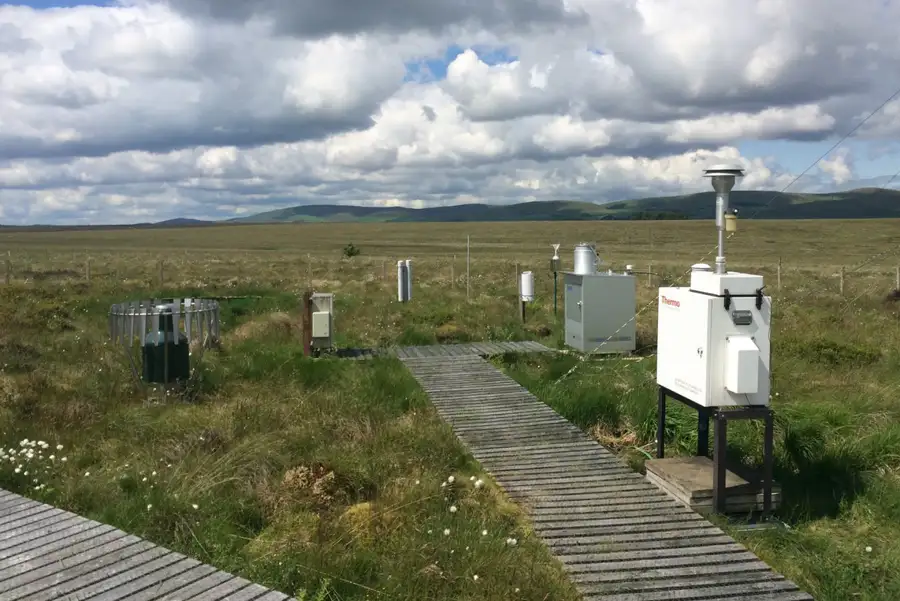
Auchencorth Moss near Edinburgh
National Physical Laboratory / Local Site Operator
Circular Economy Bill published

The Scottish Government have published the Circular Economy Bill which introduces new powers with to tackle waste and increase reuse and recycling rates.

The Legislation will give Ministers powers to:

  • Set local recycling targets, building on the experience of Wales, which has the best recycling rate in the UK
  • Set statutory targets for delivery of a circular economy to measure progress in reducing waste and the nation’s carbon footprint
  • Ban the disposal of unsold consumer goods, to prevent good products ending up in landfill
  • Place charges on single-use items like coffee cups to encourage the move to reusable alternatives

Local authorities will be given additional enforcement powers, allowing them to crack down on flytipping and littering from cars.

The Scottish Government will also work with local authorities to co-design an updated national Code of Practice for household waste recycling, to improve consistency of services and increase the quality and quantity of recycling collected.

Circular Economy Minister Lorna Slater said:

“I want everyone in the country to experience a modern, easy to use waste service that makes it easy for people to do the right thing for the planet.

“The Circular Economy Bill with give local Councils and the Scottish Government the powers they need to transform our economy and tackle throwaway culture.

“Of course, the best way of tackling waste is to not create it in the first place. There are huge economic opportunities in the circular economy and we have already seen businesses in Scotland creating jobs by turning what we might otherwise throw away into valuable new products and services.

“This legislation will support the growth of more green businesses and community organisations while cutting waste and climate emissions.”

Scottish Government Review of Permitted Development Rights – Phase 3 Consultation

The Scottish Government have released a consultation which concerns Permitted Development Rights (PDR). The phasing of the PDR programme is kept under review to ensure that it reflects – and helps to promote – wider Scottish Government objectives and priorities. In view of the cost and climate crisis, Phase 3 of the review is primarily focussed on PDR for domestic and non-domestic renewables equipment. This focus reflects the important role that such equipment can play in helping to reduce greenhouse gas emissions and energy costs for households and businesses. Linked to this, Phase 3 also considers PDR associated with the rollout of transmission and distribution infrastructure needed to support the expansion of renewables and to meet increasing demands for electricity.

You can view the consultation here – deadline for comments is 23 August.

Clean Air Day

Clean Air Day, the UK’s largest campaign on air pollution is happening on Thursday 15 June 2023. The theme is – “Clean up our air to look after your mind this #CleanAirDay”.  

The campaign is focusing on the fact that cleaning up our air is good for us in many ways: it not only benefits our physical health and the environment, but can also protect our mental and brain health. 

To get involved, visit the Clean Air Day website.  

Environmental Standards Scotland publish lecture on The European Green Deal and the Logic of Sustainable Transition

Environmental Standards Scotland has published a video of a lecture by Dr Hans Bruyninckx on The European Green Deal and the Logic of Sustainable Transition.

You can watch the full video here.

Environmental Standards Scotland provides details of their role and current activities on their website, along with recordings of recent lectures/presentations.https://www.environmentalstandards.scot/

REHIS May News

Welcome to the May Newsletter.  It has been a hectic month since our last newsletter with our Annual Environmental Health Forum and Scottish Food Safety Registration Board professional interviews taking place.  The Council launched the Strategic Plan for the next three years which features in our Spring Journal, and we have been planning some professional events which are detailed below. 

Congratulations 

The Royal Environmental Health Institute of Scotland congratulates His Majesty King Charles III and Queen Camilla on their Coronation. 

Environmental Health Scotland-The Journal of the Royal Environmental Health Institute of Scotland – Spring 2023 


REHIS Spring 2023 edition is now available.

The e-magazine format is openable and readable here.

The PDF version is available here.

REHIS Events

Food Update – Morning of Wednesday 7 June 2023 through MS Teams 

The event programme is available on the website. 

The event is just £50 for members and £100 for non-members. Student members of the Institute can book and attend free of charge. 

Specialist Investigator’s Course – 5 Days from Monday 28 August 2023, in person event, Stirling 

The course will be tailored around the subjects routinely covered by Environmental Health Officers and will include the skills relevant for work in any subject area of the profession. 

The cost for the course is £800 for REHIS members and £1200 for non-members, which includes all course materials, lunch and refreshments. 

 Noise Action Week 22 – 27 May 2023 

About Noise Action Week – Noise Action Week 

UK Government removes sunset clause for all retained EU law

UK legislation derived from the EU that was retained on the UK statute book at the point of Brexit will no longer be revoked en masse at the end of this year, the UK government has announced.

The Retained EU Law (Reform and Revocation) Bill (REUL) will be amended, removing a clause that would have scrapped any EU-derived laws that hadn’t already been replaced, repealed, or integrated into UK domestic law by December.   

The REUL, introduced to Parliament in September 2022, initially included a sunset clause, meaning the estimated 4,800 EU-era rules would automatically expired after 31 December – unless ministers had specifically decided to replace or retain them. 

A targeted list of around 600 specific pieces of secondary legislation and EU legislation is expected to be revoked at the end of 2023 instead.

Highland Council analysis waste composition

Highland Council has conducted waste composition analysis and discovered that 36% of binned household waste could be recycled or composted.

The analysis was funded by Zero Waste Scotland as part of a national analysis of the waste in household bins across Scotland.

On top of the 36% that could be recycled or composted at home, an additional 25% was food and drink in its packaging or in unopened containers, the majority of which could have been consumed.

The analysis also showed that on average refuse bins also contain glass bottles and jars , garden waste and metal, all of which are widely recycled.

2% of the waste was plastic pots, tubs, and trays – things that can go in the recycling bin when they are clean after a quick wash and dry.

The recycling rate for Highland is 37%. This includes recycling from the kerbside and Household Waste Recycling Centres.

The waste composition analysis was carried out in November 2022 using a sample of households in Contin, Evanton, Dingwall, Inverness and Strathpeffer.

Chairman of Highland Council’s communities and place committee, Graham Mackenzie said: “When we throw food away, it rots and releases methane, a greenhouse gas into the atmosphere.

“Methane gas has 80 times the warming power of carbon dioxide, a major contributor to the climate crisis.

“Getting as much recycling out of the refuse bin is the next important step as we all work towards a more sustainable waste solution and the funding from the Scottish Government’s Recycling Improvement Fund will certainly help us achieve this when the new refuse and recycling collections are introduced next year.”

Clean Air Day

Clean Air Day, the UK’s largest campaign on air pollution is happening on Thursday 15 June 2023. The theme is – “Clean up our air to look after your mind this #CleanAirDay”.  

The campaign is focusing on the fact that cleaning up our air is good for us in many ways: it not only benefits our physical health and the environment, but can also protect our mental and brain health. 

This year, REHIS will be supporting Clean Air Day by joining in on their Social Media Campaign.

Several events have been organised across the country including Aberdeen City Council has a Clean Air Day event planned with organisations including: the Cleaner Air for Aberdeen team, the ACC LEZ team, the ACC Hydrogen Project, Big Issue bikes, First Bus, Enterprise Car Club, Energy Savings Trust, Getabout, Sustrans, Original FM Radio, and the Hedge men street entertainers.

They are also organising a poster competition for primary school pupils, with the chance to win a bicycle! The posters will also be displayed at the Aberdeen Science Centre from early July until mid-August. They are also hoping to have Health Walks organised for people to participate in.

Amey Ltd is educating their employers on Clean Air Day in Scotland by refreshing and relaunching their Fuel Efficient Driving Briefs and launching a Green Travel Survey to assess what barriers their employees face in making an eco-friendlier commute. 

They are also hoping to have a Fleet Review undertaken by the Energy Saving Trust that will provide fleet decarbonisation recommendations.

To get involved, visit the Clean Air Day website.  

Noise Action Week 22 – 27 May 2023

The Institute supports Noise Action Week which is occurring on 22-27 May.

Noise Action Week is an annual initiative coordinated by Environmental Protection UK since 1996 and aims to raise the profile of unhealthy noise, simple solutions to avoid noise problems and the professionals trained to manage noise.

Noise is a major nuisance and pollutant that seriously affects people’s health and wellbeing and Environmental Health Officer provide invaluable work to resolve noise issues.

Often a noise problem is simply a lack of thought or consideration and solved by asking the noise maker to reduce the volume. However, noise management services are available to help with serious complaints. This includes:

  • local authorities
  • housing providers
  • mediation services

Noise Action Week provides a focus for all services involved in neighbourhood noise management to raise awareness of  practical solutions to noise problems and also aims to get everyone considering the impact of the noise they make.

Scottish Council’s support ban on sale of single-use vapes

A ban on the sale of single use vapes is being called for by Scottish Local Authorities amid growing health and environmental concerns.

18 Councils are actively calling on the Scottish Government to ban disposable e-cigs: Aberdeen, East Dunbartonshire, Falkirk, Fife, North Ayrshire, Dundee, West Dunbartonshire, Glasgow, Argyll and Bute, Renfrewshire, East Lothian, Moray, Edinburgh, Stirling, North Lanarkshire, Shetland and Highland.

Inverclyde Council and East Renfrewshire Council have both opted not to support the ban.

The Scottish Government is currently conducting a review of single-use vapes which includes consideration of a ban. The review will be led by Zero Waste Scotland.

Australia to ban non-prescription vapes

The Australian Government’s have published their National tobacco strategy 2023-2030 which announces that they will ban single-use, disposable vapes and also the importation of nonprescription vaping products – including those that do not contain nicotine.

To tackle youth vaping, minimum quality standards for vapes will be introduced including restricting flavours, colours and other ingredients. Vape products will require pharmaceutical-like packaging, and the allowed nicotine concentrations and volumes will be reduced.

The main points of strategy include:

  • Ban the sale of all single use disposable e-cigarettes
  • Introducing minimum quality standards on certain flavours, colours and ingredients and reducing allowable nicotine content.
  • Raise public awareness about the health impacts of e-cigarettes
  • Prohibit advertising, promotion, and sponsorship of e-cigarettes 
  • Monitor and prevent illegal importation and supply of non-prescription e-cigarettes in Australia.