All professionals are encouraged to participate in a CPD Scheme and the Institute’s Scheme of CPD provides a way for Members of the Institute to evidence their ongoing professional development in an independently assessed way. For EHOs this also offers a means to achieve Chartered EHO status.
The new website provides a more efficient way to record and submit CPD and can be found by logging into the members only section of the website.
Individual entries can be made at any time through the year, then at the end of the year, when ready to submit this is completed by selecting the relevant entries, the relevant year and hitting ‘submit’. This moves your submission to the bottom of the page and should show CPD as ‘submitted’.
Once it has been reviewed, an e mail notification is sent that something has changed and the e mail will ask the submitter to log in to view the change.
The status should have changed to either ‘approved’ or ‘more information required’ and, if the latter, will show details of what is required. The submitter can then add anything required and ‘submit’ again, and the process will be repeated.
If all is found to meet the Scheme requirements and it says ‘approved’, a certificate of compliance will be sent out in due course. For Chartered EHOs a copy of the updated e mail signature logo will also be sent.
If you have any queries regarding CPD submissions please e mail contact@
Stronger and concerted action is required across all areas of public policy to reduce air pollution and its impacts, England’s Chief Medical Officer has urged.
In his annual report Chris Whitty said that while outdoor air pollution in England has reduced significantly since the 1980s it still poses significant health threats including increasing heart disease, stroke, lung disease, cancer, child lung development, and asthma, and kills an estimated 26 000 to 38 000 people a year in England.
The report said that indoor air pollution is becoming an increasing proportion of the overall problem as outdoor air pollution improves, and called for more focus on tackling it.
According to the report people spend around 80% of their time indoors, whether for work, study or leisure. Many indoor spaces are public, and people do not have a choice about spending time in them. Despite this, indoor air pollution has been studied less than outdoors.
The report said: “Solid fuels are by far the most polluting method of domestic heating, and wood burning has increased in popularity over recent years. Reasons for burning wood and other solid fuels vary, and include aesthetic as well as practical, ecological or economic reasons. For air pollution emissions, there is substantial difference between the different open fire and stove designs, the age of the appliance and how well maintained it is, and the moisture content of the wood, for those who want to burn wood. In urban areas, burning wood has the potential to worsen local air quality significantly”
The report makes 15 recommendations across a range of sectors:
Outdoor air pollution
1. Outdoor air pollution is falling and will fall further, provided we continue and accelerate the things we know work. This requires action in many sectors, but the interventions are all realistic. We need to focus on areas where people live, study, work and have leisure.
Indoor air pollution
2. As outdoor air pollution falls, indoor air pollution becomes a greater proportion of the problem. Ventilation and reducing emissions are important. Several interventions are highlighted in the report. However, the path to improvement is not as clear as for outdoors, and further research will be needed.
Specific recommendations
Transport
The electrification of light vehicles and public transport is important for reducing air pollution from vehicle tailpipes – momentum must be maintained, and accelerated wherever possible. Emissions from tyres and road wear will not be improved by electrification, and this is a key research and innovation need.
A greater range of options for reducing air pollution emissions from heavy vehicles is needed. Some specialised vehicles such as refrigerated units need to be addressed, especially in urban areas.
The electrification of railways can significantly reduce air pollution emissions from trains and improve air quality for travellers, staff and those living nearby. Where this is not possible, bi-mode or other low-pollution technologies should be used. Closed spaces are important, for example we should look to end diesel trains being left running in enclosed stations.
Urban planning
6. With national government, local authorities are central in the response to air pollution. Urban planning should support reducing air pollution concentrations locally – such as reducing air pollution near schools and healthcare settings. Shifting to active travel where possible has direct health wins as well as reducing air pollution from vehicles – planning should support this.
Industry
7. The substantial improvements from industrial processes over recent years are impressive. Wherever possible remaining industries that emit pollution should be sited away from densely populated areas. Where they cannot, such as construction, mitigations can significantly reduce the impact and they should be adhered to.
Agriculture
8. Ammonia emissions from agriculture contributes to secondary particulate matter air pollution, which can travel large distances and affect populated areas. Significant reductions in ammonia air pollution could be achieved by precision application of slurry to, or into soil, and covering slurry-stores. There would be capital costs, but these changes could be self-sustaining afterwards.
The NHS
The NHS is committing to halving its contribution to poor air quality within a decade while reducing health inequalities.
The training of healthcare staff should include the health effects of air pollution and how to minimise these, including communication with patients.
Indoor air pollution
People spend large periods of time indoors and many indoor places are public, where individuals have little control over the quality of air they breathe. These two factors should be recognised in the planning and development of public indoor spaces.
Effective ventilation, while minimising energy use and heat loss, is a priority for reducing air pollution, respiratory infections and achieving net zero. This is a major engineering challenge which needs solving.
While there is co-ordination across government, the ownership of indoor air quality policy within government needs to be clarified.
Wood stoves and other solid fuel heating
14. The use of wood stoves is increasing and can impact air quality significantly in urban areas. Air pollution emissions can be reduced, but not fully eliminated, by using modern, less polluting stoves and burning wood that is dry. In smoke control areas, the rules should be adhered to.
Research
15. Research priorities are highlighted in the research section. Indoor air pollution in particular needs greater research interest. Policies should be evaluated once implemented.
Professor Chris Whitty, Chief Medical Officer, said:
“Everyone is affected by air pollution, and it is everyone’s problem.
Air pollution has improved and will continue improving provided we are active in tackling it. We can and should go further – and it is technically possible to do so.”
The UK Government is delaying the implementation of the introduction of further advertising restrictions on TV and online for less healthy food and drink products until 1 October 2025.
They were first scheduled to be implemented in April 2022 under the UK Government’s strategy to combat childhood obesity. Then they were postponed to October this year, and in May, they were pushed back again to January 2024.
The delay was announced by The Minister for Primary Care and Public Health, Neil O’Brien during a statement stating:
“Due to a delay to Royal Assent of the Health and Care Act 2022, and recognition that industry needs more time to prepare for the restrictions, in May 2022, Government announced a year delay to the implementation of these restrictions to 1 January 2024.
However feedback from industry and the regulators is now clear that there is insufficient time to prepare for implementation on the previously announced date of 1 January 2024.
This is because ahead of implementation there are a number of steps that need to be taken including: a Government consultation on draft regulations that are required to set out the details of the advertising restrictions, such as the definition of product categories in scope of the advertising restrictions and the definition of the exemptions for small and medium enterprises, audio only content and services connected to regulated radio; the subsequent making of such Regulations; a consultation from the statutory regulator (Ofcom) on the designation of a frontline regulator; the possible designation of a frontline regulator by Ofcom; and publication of guidance to support business compliance with advertising restrictions, following consultation on such guidance from the frontline regulator.
Through discussions with key stakeholders it is clear that this process cannot be delivered by January 2024.
We have listened carefully to the concerns raised by advertisers, broadcasters and regulators about the importance of having sufficient time with these documents to fully prepare and restructure their advertising. We also recognise that businesses need time to reformulate their products. This is why we have decided to delay implementation of this policy until 1 October 2025.
Parliament included a power in the Health and Care Act to delay implementation of the advertising restrictions if necessary. We will be utilising this power to amend the date of implementation for the advertising restrictions by secondary legislation, which we are laying today.
To illustrate our commitment to this policy, we are also launching a consultation on the definitions included in secondary legislation, to provide detail to that included in the Health and Care Act. This consultation will run for 16 weeks, until 31 March 2023.
This consultation will not be inviting opinions on the policy or looking to deviate from anything announced in the consultation response in June 2021 – it will be to confirm the clarity of the definitions used and that the text in the secondary legislation is fit for purpose.”
The Government has formulated the final policy for introducing advertising restrictions for High Fat, Salt or Sugar products on TV and online and is now seeking your views on the draft regulations that accompany primary legislation. This consultation closes at 11:45pm on 31 March 2023.
For further information please see the legislation here.
Research by Action on Sugar (based at Queen Mary University of London) has revealed the worrying levels of sugars added unnecessarily to breakfast foods intended for babies and toddlers.
Action on Sugar is now calling for the complete removal of misleading nutrition and health claims on baby and toddler food & drink products and urging the new UK Health Minister Steve Barclay to publish and mandate the overdue Commercial baby food and drink guidelines.
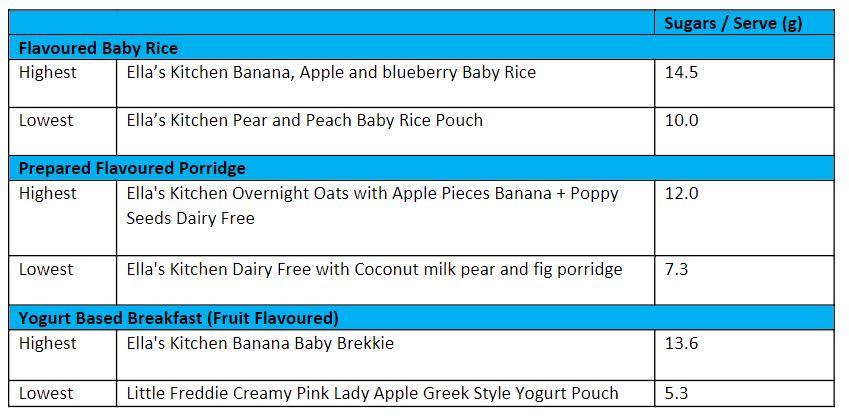
The product survey, which analysed nearly 100 baby and toddler breakfast items sold in stores, found Ella’s Kitchen’s Banana, Apple & Blueberry Baby Rice had the highest sugar per serve, with 14.5g sugars per pouch (equivalent to 4 teaspoons sugar). This was followed by Ella’s Kitchen’s Banana Baby Brekkie (13.6g per serve) and Ella’s Kitchen Bananas, Apricots + Baby Rice(13.5g per serve).
All products surveyed used nutrition or health claims on-pack and over three quarters (86%) used a ‘no added sugar’ or ‘only naturally occurring sugars’ claim. However, many add sugars in the form of fruit/vegetable juices, concentrates, purees and powders (types of sugars that should be limited) misleading parents/carers into thinking that the product is healthier than it is. Little Freddie was the only brand responsibly choosing not to use these claims on their products.
Alarmingly, Heinz By Nature Creamed Porridge uses plain sugar as an ingredient yet champions the claims ‘Only natural ingredients’ in addition to ‘Sugar from a natural source’ which is not listed as a legally permitted claim on Great Britain nutrition and health claims (NHC) register.
Babease Simply Smooth Avocado Breakfast with Yogurt, Spinach & Oats (3.5g sugars per serve)was the only product in this survey that used vegetables (no additional fruit) as a flavour for their product. This significantly reduces the overall sugars and introduces a less sweet flavour in a market that is otherwise saturated in sweet tasting breakfast products. In addition, by reducing the amount of processed fruit, flavour can be retained but sugars drastically cut by half – HiPPOrganic Banana Yogurt Breakfast, sugar content 6.9g/100g uses around 40% less banana than Ella’s Kitchen Banana Baby Brekkie, 13.6g/100g.
Whilst these products are convenient for parents and carers, findings from a public opinion poll by Action on Sugar, which sampled 1,004 parents with young children (aged between 6-36 months old) revealed two in three (65%) parents are concerned about the levels of sugar in ready-made/pre-packaged baby and toddler breakfast items, and the majority (87%) think it would be useful if the sugars added to baby and infant food, including that of processed fruit, was displayed on front of pack.
In 2016, the Government challenged the food industry to reduce the overall sugar content of certain food categories by 20% by 2020, but baby and toddler foods were not included in this programme. Instead, the UK Government released draft Commercial baby food and drink guidelines for consultation in 2020 but did not then implement these guidelines. As a result, there is currently a gap in strict nutrition guidelines for these products, alongside worrying reports of high obesity prevalence and tooth decay in children starting school.
The data published signals a clear need for robust measures to incentivise the food industry to reduce sugar across a wide range of products, including those marketed for baby and toddlers. With 91% of parents supporting government action to make sure all food and drinks available in the baby aisle are nutritionally appropriate, the overdue government guidelines for baby & toddler products are needed now to guide manufacturers on how much sugars should be used.
The former director of a free-range egg company has been jailed for a string of animal welfare and food hygiene offences which led to the deaths of 2,000 hens.
Highland Council’s Environmental Health Service and the Animal Plant and Health Agency (APHA) commenced a joint investigation in 2017 following reports of significant food hygiene and animal welfare concerns at Caithness Free Range Eggs Ltd, Lochquoy Farm, Caithness.
The lengthy investigation uncovered numerous and serious breaches of animal welfare and food safety legislation which led to a report being submitted to the Procurator Fiscal’s Office.
At Wick Sheriff Court on 1st December 2022, Peter Armitage (former director of Caithness Eggs Ltd) was sentenced to 2 years and 3 months in prison and banned from keeping animals for 15 years. His former employee Kyle Mackay was given a Community Payback Order requiring him to carry out 180 hours of unpaid work.
Both had previously pled guilty to causing approximately 2000 adult hens unnecessary suffering by failing to provide them with sufficient food and water, resulting in their deaths during the operation of the company. They also pled guilty to allowing pigs access to hens, resulting in them attacking, killing, and eating some of them.
Armitage had also pled guilty to four additional charges that included:
failing to keep the premises clean and in a good state of repair,
failing to take adequate steps to control pests,
feeding pigs with eggs and eggshells and
failing to take reasonable measures to protect them (hens) from suffering and disease.
Mackay pled guilty to a further charge of failing to provide sufficient food and water to a calf which resulted in its death.
Wick Sheriff Court heard the offences occurred between September 2016 and September 2017.
The court heard the company came to the attention of the council following an anonymous email on 7 July 2017. It stated: “Rats and dead chickens lying everywhere the place is disgusting they need shut down, this place is not up to standards for any animal to live in, the poor chickens look like they are dying.”
On 18 July 2017 an unannounced inspection was carried out council environmental health officers and the Animal and Plant Health Agency. The team discovered dead birds and parts of dead birds as they walked around the farm, which was in a poor state of repair. They also witnessed pigs roaming around the outbuildings and chicken houses, some with chicken feet and feathers hanging out of their mouths.
One of the chicken sheds was also found to be “carpeted” with what looked like a whole flock of decomposing birds. Bird carcasses were also found within the egg collection areas, where trays of boxed eggs on benches were covered in bird faeces and rat droppings. A farm worker said that the chickens had been dead for “about a month and a half”.
The following day a second inspection found the hens and pigs had access to bait boxes which contained rat poison. Armitage ceased trading with immediate effect and was told to stop feeding the pigs raw eggs and prevent them from accessing the hen houses.
Following the sentencing Andy Shanks, procurator fiscal for Grampian, Highland and Islands, said:
“The animal welfare and hygiene failings at Lochquoy Farm caused unnecessary suffering and pain to thousands of birds and introduced a significant public health risk through the supply of potentially contaminated eggs to wholesale and retail outlets across the Highland region.”
Councillor Graham MacKenzie, Chair of Communities and Place Committee said:
“This was one of the most complex and difficult cases undertaken by the Environmental Health team. The officers involved were faced with quite harrowing animal welfare issues on site and found almost a total disregard for the basic hygiene levels that would be expected in a food business.”
Alan Yates, Highland Council Strategic Lead Officer for Environmental Health, said:
“The Service welcomes the significant sentences which we consider reflects the seriousness of the animal welfare and food safety offences. The conditions on the farm resulted in the suffering and death of thousands of birds and created a significant public health risk through the supply of potentially contaminated eggs to businesses across the Highlands. Officers from environmental health responded quickly to the initial complaint and took prompt, appropriate action to deal with the terrible hygiene and welfare conditions found.
“As shown in this case, officers will pursue prosecution where significant offences are found and where public health and animal welfare is put at risk. Food businesses and farms must give due attention to their legal responsibilities.”
He added: “This was a complex animal welfare and food hygiene case with multiple issues that required close cooperation between the agencies involved. Professional veterinary opinion and forensic pathology provided by the Veterinary Inspectors from the Animal and Plant Health Agency (APHA) and Scotland’s Rural College (SRUC) Veterinary Services, in conjunction with inspectors from Scottish Government Poultry Inspection Unit, supported Highland Council Environmental Health officers to ensure an early intervention and successful conclusion to what was a particularly traumatic case.”
On Monday 5 December 2022, a Wiltshire man was served with a confiscation order under the Proceeds of Crime Act and ordered to pay back over £150K by Swindon Crown Court.
In December 2021, Gent Jakupi was given a six month custodial sentence after pleading guilty to 39 food hygiene offences relating to placing unfit meat on the market and other associated hygiene offences.
The initial prosecution of Gent Jakupi followed raids by Wiltshire Council’s Food and Safety Team on his illicit meat butchery and delivery business operating from hand car wash premises in October and November 2020. Working with the Food Standards Agency, a national food alert was issued warning that meat that had already been supplied was unfit for consumption. In addition, a total of 5.1 tonnes of meat was seized from his premises and condemned for destruction.
Following the conviction of Gent Jakupi, a Proceeds of Crime investigation was conducted by the Food Standards Agency’s National Food Crime Unit on behalf of Wiltshire Council. The investigation concluded that he had gained significant financial benefit from his offending and found to have made £154,342.62 from his criminal conduct with £3,500 currently available for confiscation. He has been ordered to pay within three months or face a default prison term of three months in addition to his original sentence.
Senior Financial Investigator, Yvonne Barwani, of the National Food Crime unit who conducted the Proceeds of Crime investigation for the Council said “This is a satisfying result and shows that food crime does not pay. This investigation and subsequent prosecution also provide a good example of organisations working closely together to ensure that consumers are protected from illegal activity”
Cllr Ian Blair Pilling, Cabinet Member for Public Protection, Wiltshire Council said; “I am pleased that in addition to the original conviction and custodial sentence, Mr Jakupi has been ordered to pay back his ill-gotten gains.
This was one of the worst cases that our Food and Safety team have dealt with and the defendant put consumers and their families at serious risk. I hope that this will act as a warning to others that this dangerous behaviour will not be tolerated in Wiltshire and that they will not prosper from it.
I would also like to thank our Food and Safety team and the National Food Crime Unit of the Food Standards Agency for their hard work.”
A study of online alcohol sales has revealed serious inadequacies when it comes to the availability of mandatory alcohol health information and warnings.
Online retailers are doing a “woeful” job of alerting consumers to alcohol health information and warnings, according to the results of a University of Auckland-led study.
The study examined the presence, type and location of mandatory and voluntary health information and warnings consumers are exposed to when shopping online for alcohol in the United Kingdom and Aotearoa New Zealand.
A total of 1407 randomly sampled alcoholic beverages (705 in Aotearoa and 702 in the UK) from 14 online alcohol retailers (seven per country) were reviewed.
“The study identified woeful inadequacies regarding the viewing of mandatory alcohol health information within an online retail setting, as well as a near absence of any voluntary health warnings on alcoholic beverages,” says Business School Associate Professor Bodo Lang, one of the study authors.
“While consumers in both the UK and Aotearoa do not have sufficient opportunity to be exposed to health information and warnings, New Zealand consumers are particularly at risk because of low levels of information provision at the online point of sale.”
Even though certain beverage information and health warnings are not mandatory in the UK, says Dr Lang, consumers there have a far greater chance of being exposed to health information than in New Zealand, where such information is mandatory.
For example, despite the number of drinks per bottle being a mandatory display requirement for online alcohol sales in Aotearoa, the study found that just five percent of the beverages examined had the number of drinks per bottle displayed on either the product page or imagery. Meanwhile, displaying the number of drinks per bottle in the UK isn’t required; however, the information was available for 69 percent of the drinks advertised.
Showing the alcohol by volume percentage of a drink is also mandatory in Aotearoa but not in the UK. However, the study found that online alcohol retailers in the UK were also more inclined to display this information than New Zealand retailers.
The alcohol percentage information was visible on the product page for 92 percent of alcoholic beverages sold online in the UK, compared to 31 percent in Aotearoa. It was displayed on the product imagery of 38 percent of the 705 New Zealand drinks sampled and 43 percent of the 702 UK drinks. Meanwhile, 69 percent of alcoholic beverages in New Zealand online stores did not display alcohol volume percentage at all, compared to eight percent of the UK sample.
Unfortunately, consumers are even less likely to be exposed to this health information than the numbers suggest, says Dr Lang.
“Most consumers don’t click on product images, and as such, they’re limited to the information provided on the product page.
“When taking this into account, the opportunity to be exposed to mandatory information drops further. For example, the standard drinks per bottle were not visible for a single product on New Zealand retailers’ product pages.”
In a newly-published paper detailing the study findings titled It’s somewhere here, isn’t it? The provision of information and health warnings for alcoholic beverages sold online in New Zealand and the United Kingdom, Lang and his co-authors say that the lack of clearly visible information online impacts the ability of consumers to make informed purchase decisions.
“In both countries, alcohol policy needs to stipulate that mandatory health information and warnings should be clearly viewable on the product page and product imagery of online alcohol retailers.”
The UK Health Security Agency (UKHSA) and the British Geological Survey (BGS) have published an updated radon potential map for Great Britain.
The risk of developing lung cancer from exposure to radon remains low and the vast majority of buildings remain outside Affected Areas.
Individuals and employers are encouraged to check the map to see if a radon test is advised in homes and workplaces in their area.
The updated radon potential map, produced by UKHSA and BGS, is the first in over 10 years and provides an authoritative analysis of the likelihood of a building being in a radon Affected Area (an area with higher radon potential).
Radon is a colourless and odourless gas that is attributed to 1,100 lung cancer deaths per year in the United Kingdom. The risk is highest among smokers and ex-smokers.
For most people, the risk of developing lung cancer from exposure to radon remains low and levels of radon have not increased across the UK. However, UKHSA advises you to test your home if you live or work in an Affected Area. There are several methods of reducing high radon levels in buildings.
The latest update to the map, available to view at UKradon.org, is the product of years of new analysis and research, combining the latest geological mapping with one of the largest databases of in-home measurements ever compiled.
While the vast majority of buildings remain outside radon Affected Areas, this new map has refined our knowledge of areas where high radon levels are more likely to occur. The overall number of buildings with high radon levels remains the same.
The radon map allows local councils, national and regional governments, social and private landlords, private homeowners and employers to assess the radon risk in their properties. It is also used in building regulations to inform where radon preventative measures should be incorporated in new buildings.
Tracy Gooding, principal radiation protection scientist at UKHSA, said:
While the vast majority of buildings remain outside radon Affected Areas, if the property you own is in a radon Affected Area, it is important that you arrange for a test. If you live in private or social rented accommodation, speak to your landlord, who should organise a test for you to carry out.
Employers can use this map to help undertake a suitable and sufficient risk assessment and take appropriate action where necessary.
The updated map provides information that allows property owners, landlords and employers to make informed decisions on the benefits of undertaking radon measurements and potential remediation work.
Russell Lawley, principal geologist at BGS, said:
Radon occurs in all rocks and soils. Using a revised statistical approach to our mapping of geology across Great Britain has enabled us to model where this geo-hazard is more likely to be present in buildings.
This map is a significant update to the previously published version and will help to raise awareness about this geohazard.
We are delighted to welcome Jacqueline as the newest staff member to join the REHIS team. She commences her new role just before Christmas as the Director of Professional Development, on a job share basis, working with Karen Keeley.
Many of you will know Jacqueline already as she has been involved in the world of Environmental Health for some time.
After graduating from Strathclyde University in 1993 and obtaining her REHIS post graduate diploma in 1994, she worked with Hamilton District Council, Bearsden and Milngavie District Council, then East Dunbartonshire Council before moving to SEPA where she held a number of posts leading to her last role within SEPA’s corporate office.
Jacqueline moved to Portugal in 2012, initially on a career break, as her husband had secured a new role within the EU Drugs Agency and she continues to live there with her family. However, she maintains her involvement with the profession from overseas and is a Chartered Environmental Health Officer.
Her role within REHIS will involve remote working, as the pandemic has radically changed the way we work and introduced a greater degree of flexibility. Jacqueline will work with Karen ensuring that Environmental Health Professionals maintain their CPD, are presented with appropriate development opportunities and that the training of our students evolves as the world around us changes.
Congratulations to Jacqueline, we wish her all the best in her new role.
We would also like to take this opportunity to thank all applicants for their interest in working for the Institute and to all those who assisted in the recruitment process.
The Institute’s Annual General Meeting was held on Friday 18 November at the Edinburgh Training and Conference Centre with over eighty members attending, some in person and others via MS Teams. Louise Cunningham gave her Presidential Report reflecting on the previous year in her role as President. Prior to the AGM was the Institute’s annual Environmental Health Update where we heard from an excellent line up of speakers.
Evonne Bauer has now been installed as the Institute’s President for the coming year. Congratulations to Evonne and all the newly elected Members of the Council. You can view the Council Members here.
The latest data published by Public Health Scotland (PHS) has concluded that Minimum Unit Pricing has reduced overall alcohol sales.
The study, carried out in collaboration with the University of Glasgow, shows a net reduction in total per-adult sales of alcohol of three percent in the three years following the implementation of MUP in 2018.
This reflects a 1.1% fall in Scotland in contrast to a 2.4% increase in England and Wales. The net reduction in total alcohol sales was driven by a reduction in per-adult sales of alcohol through the off-trade (supermarkets and other shops), with no observed impact to sales through the on-trade (restaurants and bars).
This work builds on an earlier report which demonstrated a similar fall in off-trade alcohol sales in the first 12 months following the implementation of MUP. This latest work strengthens these findings by demonstrating that initial fall in alcohol sales was maintained throughout the three years following the introduction of the legislation in Scotland. The methods used, such as including adjustment for a geographical control and for COVID-19 associated restrictions, provide confidence that the reduction in sales demonstrated are a result of the implementation of MUP.
Lucie Giles, Public Health Intelligence Principal at PHS, said:
“The latest data shows a reduction in per-adult sales of pure alcohol in Scotland at the same time an increase in England and Wales was observed. We found net reductions in per-adult sales of cider, perry, spirits and beer, and net increases in per-adult sales of fortified wine and wine. Taken together, the overall impact of MUP on total per-adult alcohol sales in Scotland was a 3% net reduction, driven by a reduction in off-trade sales. We found little evidence to suggest that MUP caused any changes in per-adult sales of alcohol through the on-trade, suggesting that MUP did not cause a substantial shift towards alcohol consumption in pubs.
“Our main finding was consistent across a range of different conditions as tested through our additional analyses. We can conclude that, across Scotland as a whole, MUP has been effective in reducing alcohol consumption in the first three years of implementation.”
Jim Lewsey, Professor of Medical Statistics at the School of Health and Wellbeing, University of Glasgow, said:
“The methods we’ve used in this study allow us to be confident that the reduction in per-adult alcohol sales that we’ve shown is as a result of the introduction of MUP, rather than some other factor. Incorporating data from England & Wales into our analysis controls for any changes in sales in a neighbouring region where the legislation was not introduced. This was of particular importance with the COVID-19 pandemic occurring in our three year post-intervention study period, as we know the pandemic impacted on where people were able to purchase alcohol.
“We’ve been able to adjust for other factors, such as household income, sales of alcohol through pubs and clubs and of other drink types. This statistical method also allows us to take into consideration any existing trends and seasonal variation in the data, which may have existed independently of MUP, but which could have impacted on alcohol sales following its introduction. The methods we’ve used and the consistency in our results allow us to be confident that the reduction in alcohol sales is associated with the introduction of MUP in Scotland.”
The MUP Evaluation Portfolio comprises a number of research studies that are being undertaken to assess the impact of MUP across a range of outcomes, many of which have already concluded. A report bringing together all of the evaluation findings will be published in 2023.
The inquest into the death of two-year-old Awaab Ishak concluded on 15 November 2022, with the Coroner finding Awaab died as a result of a severe respiratory condition due to prolonged exposure to mould in his home environment.
The inquest was heard over seven days at North Manchester Coroner’s Court in front of HM Senior Coroner Ms Joanne Kearsley.
Awaab sadly passed away on 21 December 2020, aged just two years old. He lived at home with his parents in a housing estate in Rochdale, managed by Rochdale Boroughwide Housing (RBH). Awaab’s parents had previously made complaints about the black mould present in the kitchen and bathroom and had also made requests for re-housing.
Over the weeks prior to his death, Awaab developed flu-like symptoms and had difficulty breathing. On 19 December 2020, he was taken to Rochdale Urgent Care Centre due to his difficulty breathing and was then transferred to Royal Oldham Hospital, where he was given supporting treatment and then discharged.
Awaab continued with difficulties at home and his breathing became worse, so his parents requested a GP and gave him medication. As his presentation was worsening, he was taken to Rochdale Urgent Care Centre on 21 December 2020, where he was found to be in respiratory failure. He was transferred to Royal Oldham Hospital where upon arrival he was in cardiac arrest and sadly was pronounced dead on the same day.
The Court heard how Awaab’s health visitor sent a letter to RBH in July 2020 supporting a request for the family to move due to damp and mould. She expressed her concern over Awaab living in the flat and highlighted the health issues that the mould could cause him.
The Coroner has found the cause of death was:
1a) Acute airway Oedema with severe granulomatous tracheobronchitis
1b) Environmental Mould Exposure
The inquest heard evidence from a number of experts, medical professionals, and staff at RBH.
Pathologist Dr Philip Lumb who carried out Awaab’s post-mortem told the Court that Awaab’s throat was swollen to a degree that would compromise his breathing. His windpipe and other airways were also swollen and congested. There was evidence of fungus in his blood and lungs, and exposure to fungi was the most plausible explanation for the inflammation.
The inquest also heard from Professor Malcolm Richardson, who is an expert on moulds and fungi and their effect on health. He examined the family’s flat 10 days after Awaab died and found “extensive mould” on the walls and ceilings of the bathroom and kitchen and also found mould in a cupboard in the bedroom. He told the Court that the flat would have been contaminated “for some considerable time”.
Rochdale Council building surveyor, Daniel McVey, inspected the property two days after Awaab’s death and told the Court that it was not fit for human habitation without repairs being carried out. Despite this, Awaab’s parents had to continue living in the flat following Awaab’s death following unsuccessful requests for rehousing, despite Awaab’s mother being pregnant at the time.
Richard Blakeway of the Housing Ombudsman for England told the Court that the law needs to be reinforced to compel landlords to address damp and mould problems, as the issue is not given the same legal standing as gas safety and legionella. He said that some social landlords have an “outdated, ineffective, sometimes dismissive” approach with an overemphasis on blaming the tenant’s lifestyle.
We use cookies to ensure that we give you the best experience on our website. If you continue to use this site we will assume that you are happy with it.