NHS Louisa Jordan to close

The hospital set up to support Scotland’s response to the coronavirus (COVID-19) pandemic is to close on 31 March, with the mass vaccination centre relocating to The SSE Hydro.

Thanks to the public’s continued efforts to reduce the spread of the virus, the NHS Louisa Jordan was not required to treat COVID-19 patients. Since July 2020 the hospital has played a crucial role in supporting the remobilisation of NHS Scotland.

With NHS services remobilising across the country, NHS staff at the Louisa Jordan will return to their own health boards or support the vaccination programme at The SSE Hydro. The Scottish Events Campus will be returned to a working events and conference centre, including preparing to host COP26.

By 31 March staff at the hospital will have carried out more than 32,000 outpatient and diagnostic appointments, trained over 6,900 healthcare staff and students, and vaccinated approximately 175,000 people across the Greater Glasgow and Clyde area. The site has also supported the Scottish Blood Transfusion Service, with over 500 donations being carried out, as well as providing Occupational Health services for the University of Glasgow for nearly 1,000 people.

Once relocated to The SSE Hydro, the centre will continue to run daily clinics with the ability to administer a minimum of 4,000 vaccinations each day, with capacity to scale up to 10,000.

Aberdeen City Council secures funding for more hydrogen buses

Funding of £4.5 million has been awarded to Aberdeen City Council for the introduction of 10 new hydrogen buses, taking the city’s hydrogen-powered bus fleet total to 25.

The money comes from the £62 million Energy Transition Fund which was set up to help ensure a green recovery from the coronavirus (COVID-19) pandemic and support the energy sector’s transition to a net-zero economy.

With a focus on the North East, the fund underpins the region’s ambitions to become a world leader in the transition to net zero, creating green jobs and growing the local economy.

Commenting on the planned deployments, Scotland’s Energy Minister, Paul Wheelhouse, said, “The Scottish Government is wholly committed to ending Scotland’s contribution to climate change, and doing so in a way that ensures no-one is left behind as our economy undergoes the transformation required to reach net zero.”

“It is vital we seize the opportunity to take forward a green, low-carbon recovery and support our energy workforce as the sector diversifies. Now is the time to re-imagine the Scotland around us and to ensure we build a greener, fairer and more equal society and economy.”

Aberdeen City Council Co-Lead Councillor, Jenny Laing, added, “We are delighted to have been awarded £4.5 million from the Energy Transition Fund as the investment will contribute to the funding of 10 additional hydrogen double decker buses.”

“These vehicles will increase the world’s first hydrogen double decker bus fleet in Aberdeen to 25 and complement one of the largest and most varied fleets of hydrogen vehicles across Europe which includes cars, vans, road sweepers and waste trucks.

Routine testing rolled out to high-risk workplaces

Food production and processing businesses are being urged to sign up for routine staff testing to help identify cases of coronavirus (COVID-19), keep workforces safe and break chains of transmission.

Free lateral flow antigen test kits are available to eligible businesses which are essential to maintaining an adequate supply of food for the nation, and where outbreak risks can be higher due to the working environment such as abattoirs, meat and seafood processing facilities and dairies, as well as food distribution businesses.

A number of businesses have already signed up as early adopters, including critical businesses such as the Coupar Angus poultry plant and a number of seafood processors in Grampian – some of which have been affected by COVID outbreaks.

The Scottish Government would like to hear from larger (over 25 employees) higher risk food processing businesses such as abattoirs, meat and seafood processing and dairies where, despite mitigations already in place, a combination of low temperatures, limited ventilation, low light, high humidity can facilitate spread of the virus and lead to outbreaks. 

We would also like to hear from food distribution businesses where the loss of a facility due to an outbreak could lead to impacts on food supply by reducing supplies to retail or hindering exports. The Scottish Government and Food Standards Scotland will determine whether a business falls within the criteria.

This programme is run in partnership with UK Department for Health and Social Care (DHSC) and NHS Scotland Test and Protect.

Full and detailed guidance will be available to help businesses. 

If your business would be interested in taking part, please email FoodSupplyInformation@gov.scot with the following information:

  • Name and Email for main point of contact
  • Business Name
  • Industry sector – This should be the standard industry code (e.g. 46380 – Wholesale of other food, including fish, crustaceans and molluscs). For companies this can be found on your Companies House registration.
  • Number of employees
  • Company registration number (if applicable)
  • Address where the test kits would be delivered to (including postcode)

Environmental Health Manifesto for Scotland

The Environmental Health Manifesto for Scotland explains what Environmental Health is, its importance to the continued protection of Scotland’s public health both now and in the future and describes how Environmental Health Officers (EHOs) and the wider environmental health workforce can help policy makers achieve their objectives. It also sets out four challenges facing the profession and the wider Scottish public. 

2021 is a momentous year for environmental health in Scotland. We are dealing with the Coronavirus pandemic and planning the country’s recovery as well as dealing with the consequences of the EU exit. The United Nations Climate Summit (COP26) is due to take place in Glasgow and will shine light on our commitment to sustainability. Against this background, the pre-existing pressures on environmental health in the places we live, work and travel have not gone away.

The Royal Environmental Health Institute of Scotland firmly believes that there are four key challenges to protect and improve Scotland’s environmental health and to support our communities through, and beyond, the Coronavirus pandemic. 

We address these challenges to politicians of all parties. The Institute is ready to work with all stakeholders to face the challenges and to improve, and protect, public health in Scotland.

You can read the manifesto here.

Elementary Cooking Skills – Remote Learning

Since REHIS introduced temporary regulations last March allowing courses to be delivered virtually many REHIS Approved Training Centres have risen to the challenge and offered virtual training via platforms such as Zoom and MS Teams. Many course presenters have done a fantastic job of adapting their training methods and course materials and made the transition to remote learning for many REHIS courses.

Delivering courses virtually is certainly not without its challenges, even more so for a practical course such as Elementary Cooking Skills. As well as the technical details, there are some additional factors to consider for a virtual cooking session, such as participant access to equipment, facilities and ingredients and how best demonstrate and assess preparation and cooking skills and techniques.

Yet, despite all these challenges, REHIS is delighted to see that some of our Cooking Skills presenters have been able to run virtual cooking sessions so that participants are able to learn valuable cooking skills through making a variety of dishes in their own homes. These have proved to be a success – participants are still able to interact and chat with other group members as well as tasting and evaluating their finished dishes. Our Cooking Skills course presenters have shown that with careful planning and lots of enthusiasm it is possible to adapt and deliver quality practical training remotely.

Food Standards Scotland has updated its COVID-19 Guidance for Food Business Operators and their Employees

Food Standards Scotland have updated its guidance for food business operators (FBOs) and their employees on 15 March.

 A summary of the changes in the update are as follows:

  • Updating of language used, to ensure all text is in line with current COVID-19 situation.
  • Insertion of updated Scottish Government Strategic Framework link.
  • Insertion of section on vaccination along with links to additional information.
  • Summary blue box text changes to reflect importance of FACTS across all businesses.
  • Shielding section updated text, highlighting where all up to date information can be found.
  • Face covering language edited and indoor communal area use clarified, alongside the addition of the British Retail Consortium specification for textile barrier face coverings.
  • Addition of Transport Scotland advice on how to travel safely.

COVID- Diary – Lorna Ross

Lorna Ross, Food & Safety Support Officer at Aberdeenshire Council discusses how taking the plunge to online learning has resulted in a positive change and how learning in person may be a thing of the past. 

1. Describe you work before the pandemic? 

Life before COVID-19 was busy, 4 or 5 courses a week including weekends and Saturdays for some clients. I was presenting nearly the full range of REHIS courses from Food Hygiene, Health & Safety, Infection Control and my personal favourite HACCP, at all levels from Elementary to Advanced.  Each day was different as my area covered the whole of Aberdeenshire from Laurencekirk in the South to Portsoy in the North and everywhere in between.  On some occasions I even got to break out of the ‘Shire to as far away as Elgin or even once to the Shetland Isles!  I loved meeting new people, seeing their enthusiasm for the topic grow and watch new friendships being formed in the room.  Having delegates successfully pass their end of course exam was the cherry on the cake, but the learning journey was far more important to me, as it was during that journey that new best practice would really be embedded.  I wasn’t stuck in an office all the time so I could honestly say that for each and every day I loved my job.

2. What have you been doing since the pandemic started? 

Everything was rosy in the garden then COVID-19 came along! At first I thought it would be a wee short lived problem so cancelled the courses for the coming month, then extended it to 2 months until finally admitting that COVID-19 was winning, so all future face to face courses were cancelled.  I don’t mind admitting that it was a really scary time, as effectively my own job was now cancelled, so what on earth do I do now!  A quick phone call and discussion with Jackie McCabe then quickly put me on the new track, as REHIS had approved the use of virtual video exams.  Now that was something I could work with, if I can’t train people in a meeting room, could I train them in their living room? After much trial and error, sleepless nights and a bit of swearing I cobbled together an online course that could be done from any device then concluding with a video exam and Microsoft Forms.  It is by no means perfect but hey Rome wasn’t built in a day, and I do work for the Local Authority so nothing happens that fast!!

3. What are/were the challenges? 

Where do I start with the challenges!? For anyone who doesn’t know, Aberdeenshire is just under 2500 square miles of hills, valleys, trees, small villages, and a few larger towns not an area renowned for its superfast broadband!  The lack of viable broadband coupled with a variety of electronic devices being used in peoples own homes made for intermittent meetings, breaks in communication and more than its fair share of ‘try logging out and back in again’ moments.  For a lot of my candidates this would be their first venture into online training, so the fear of the unknown added to the fear of the course material itself.  Getting access to the best computer packages was another hurdle that I haven’t quite overcome yet, as being a local authority closed a lot of doors as we are not seen as a centre of learning. 

More personal challenges also had to be overcome.  I had gone from meeting up to 100 new people each week to working at home with a farmer husband who funnily enough could not work from home, and a wee border terrier who is not much of a conservationist! Anyone who knows me, will know I am not best known for being quiet and not speaking, so this was hard.  Thanks goodness for colleagues who felt in the same boat, so lots of venting could be had over Skype!! And here I am more than a year sitting in the same spot in my house, still powering on.

4. Do you think any of these changes will last beyond the pandemic period? 

To be honest I think the old way of training and learning is a thing of the past.  Having 20-25 complete strangers in a room at the same time for up to 8 hours will not be happening anytime soon if at all, so we need to brave a new future.  I was not a huge fan of the thought of blended learning at first, but after I pulled up my big girl pants I realised that if I could do it well, it would work.   I think the awareness of supporting delegates while they are training is more important than ever, and not just knowledge support, but listening to them, hearing their concerns and being flexible.  I have had to reschedule exams last minute, due to family emergencies, to unforeseen work commitments and even once because a tractor and trailer of cattle had broken down!  Planning courses months in advance and hoping people can book on, will be replaced by more tailored training reacting to the delegate needs rather than when I fancy training in Stonehaven!  Change can be good if done in the right way, so bring it on.

No Smoking Day 2021

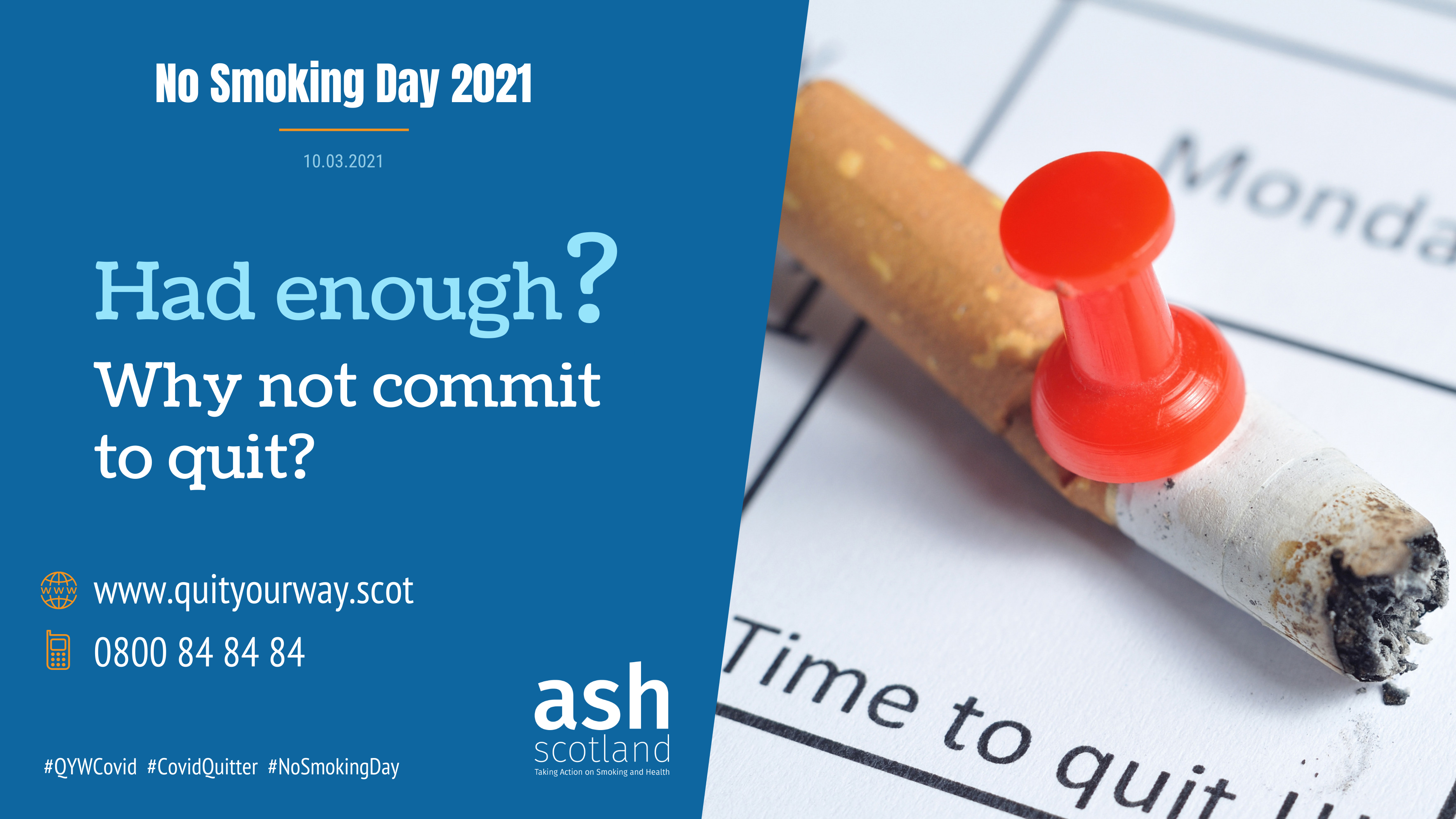
This Wednesday, 10 March is No Smoking Day.  ASH Scotland is celebrating the day by encouraging people to quit smoking by sharing the stories of people who have successfully stopped smoking during lockdown. 

This year has been tough for everyone and people are coping as best they can.  For some, that means smoking more than they normally would.  In fact, a recent Scottish Government survey found that more than a third (36%) of people who smoke report smoking more during lockdown – with just 8% saying they are smoking less.

We know that quitting smoking is one of the best things you can do for your physical health and it also improves your mental wellbeing. Trying to quit smoking at this time may feel overwhelming, but help and support to stop smoking is available through Quit Your Way Scotland, even during lockdown.

Want to help spread the word about No Smoking Day?  Please follow @ASHScotland on Twitter and share our content on 10 March.  If you or someone you know is thinking about stopping smoking, Quit Your Way Scotland can provide all the help and support you need to get started on your quit journey. 

Asymptomatic testing being rolled out across the country

Asymptomatic testing sites are being rolled out across the country following successfully trial in Johnstone in December.

Community testing in areas with high coronavirus (COVID-19) prevalence are a way of identifying positive cases in communities and breaking chains of transmission.

The sites are being delivered by Local Authorities in partnership with NHS Boards and are being funded by the Scottish Government. Environmental Health departments within Local Authorities have had large amount on input to the delivery of these sites. 

Fife has set up a testing site in Cowdenbeath with four more sites in different areas across Fife opening in the coming weeks. Meanwhile, two sites in Glasgow are also opening up 1 March and are being staffed by the Armed forces. Another site in East Renfrewshire in Barrhead will also be opening on 1 March. 

Further proposals for Ayrshire & Arran, Dumfries & Galloway, Greater Glasgow & Clyde, and Grampian have been agreed, and discussions are underway with a number of other boards and local authorities for agreement.

The sites will provide lateral flow testing, followed by a confirmatory PCR test if the first result is positive. 

Community testing has continued in the meantime with Mobile Test Units deployed since 18 January to provide testing for people with and without symptoms in the following communities: Maybole, Grangemouth, Langholm, West Linton, Sauchie, Denny, and Hawick. Data on the number of people tested and positivity rates at these sites will be published by Public Health Scotland.

In addition, waste-water tests and the most up-to-date data will be used to identify communities where asymptomatic testing is needed. Additional mobile testing will also be under-taken as a rapid response to any outbreaks.

Public Health Minister Mairi Gougeon said: "Targeted testing in this way will help us find and isolate more cases, by targeting resources with communities where there is high prevalence, helping us to identify more cases of the virus and giving us all a better chance of stopping it from spreading.

"However, a test only tells us if we are positive at the point in time that we are being tested.  It does not mean that we can stop following all of the rules and guidelines which are in place to protect all of us. Testing is only one layer of protection against this virus – all others, including vaccination and the FACTS guidance work to greatest effect when they work together, so it is essential people continue to follow the restrictions currently in place to suppress COVID to the lowest possible level in Scotland.

"This expansion has been made possible as our testing capacity has increased but it could not have happened without the support of our local partners, and everyone involved in Scotland's testing programme, from diagnostic staff to sample takers, and I want to pay tribute to each and every one of you as we continue to work to suppress this virus together."

Dr Linda de Caestecker, Public Health Director for NHS Greater Glasgow and Clyde, said: "We know that COVID-19 is often spread by people who don't have symptoms or they are so mild they do not recognise they have the infection. 

"Asymptomatic testing enables identification of infection so that people are not spreading the infection to their families, work colleagues or the wider community as they go shopping or exercising. This has the potential to reduce spread overall. That means we will be more likely to be able to reduce restrictions more quickly.  Asymptomatic testing will also help us learn about the rate of infection in people not showing signs of the virus.  Please come forward for testing to help to reduce transmission of the virus in this area. The centres will also give advice about support for isolation for people with a positive test.

"As we're asking people with no symptoms to come forward, we are highlighting the fact that it is possible to have the virus and feel absolutely fine or have vague and mild symptoms- which is why it is so important that people continue to maintain physical distancing, and use face coverings and hand-washing as additional measures of protection against the virus."

 

Scotland’s Carbon Footprint: 1998-2017

Scotland's Chief Statistician has published Scotland’s Carbon Footprint: 1998-2017. This publication provides estimates of Scotland’s greenhouse gas emissions on a consumption basis; that is emissions that are associated with the spending of Scottish residents on goods and services, wherever in the world these emissions arise, together with emissions directly generated by Scottish households.

Key points:

·       Between 2016 and 2017, Scotland’s carbon footprint (emissions from all greenhouse gases) decreased by 3.5 per cent to a record low of 70.7 million tonnes of carbon dioxide equivalent (MtCO2e).

·       Between 1998 and 2017, Scotland’s carbon footprint fell by 21.1 per cent, from 89.6 MtCO2e in 1998 to 70.7 MtCO2e in 2017.

·       Scotland’s carbon footprint rose from 1999 onwards to a peak of 101.1 MtCO2e in 2007 before falling sharply in the following years (coinciding with the recession) and has generally fallen gradually in more recent years. The overall reduction between the 2007 peak and 2017 is 30.0 per cent.

You can read the full statistical publication.

Avian Influenza Case

Bird keepers in Scotland are reminded to maximise biosecurity and keep their flocks housed after avian influenza (H5N1) was confirmed in a flock of approximately 14,000 mixed gamebirds on a gamebird rearing premises in Leven, Glenrothes.

Laboratory results of samples taken from the flock have identified the strain as highly pathogenic in poultry. In order to limit the further spread of disease, appropriate restrictions have been imposed on the premises.

A Protection Zone (PZ) of 3 km and a Surveillance Zone (SZ) of 10 km have now been put in place around the infected premises to limit the risk of spread of the disease. Within these zones a range of controls are in place, including restrictions on the movement of poultry, carcasses, eggs, used poultry litter and manure. Legislation for the H5N1 strain require a Restricted Zone (RZ) to also be declared. However, this RZ will also be 10 km and will have the same extent as the PZ and SZ, with no additional measures.

Public health advice is that the risk to human health from the virus is very low and food standards bodies advise that avian influenzas pose a very low food safety risk for UK consumers, and it does not affect the consumption of poultry products including eggs.

Producers and bird keepers are reminded to comply with the order to house birds that came in to effect on the 14 December 2020, or ensure they are kept separate from wild birds and follow biosecurity procedures.

Expansion of Testing

Access to testing to find cases and interrupt transmission already taking place in Scotland is being stepped up.

Routine testing of healthcare workers has been expanded to cover patient-facing primary care workers such as GPs, dentists, optometrists and pharmacists, as well as testing for all patient-facing staff who work in hospices.

From later this month, regular testing will be offered to support the return to schools and nurseries. Senior phase secondary school students, and all staff in primary, secondary and special schools, including school-based ELC staff, will be able to benefit from routine at-home testing two times a week

Certain workplaces where the risk of transmission is greater and which provide essential or critical services, such as those within the food processing and distribution sectors and staff within emergency service control rooms, will also be supported to introduce routine workforce testing

Targeted community testing will continue to be expanded – so that testing is available to people locally, regardless of whether or not they have symptoms

In addition,  testing is also be offered to all close contacts of people who have tested positive for COVID-enabling Test and Protect teams to identify their contacts and track, and break further, chains of transmission.