BBC Panorama programme on funfair safety

A BBC Panorama investigation has raised serious concerns over the effectiveness of the UK’s funfair ride safety regime, following a string of incidents involving injuries and inspection failures.

There were 3,188 injuries in England, Scotland and Wales between April 2014 and March 2024, including slips, trips and falls, with 350 in 2023/24, according to a Freedom of Information (FOI) request put to the Health and Safety Executive (HSE).

Broadcast on 3 June 2024, the programme focused on a catalogue of ride accidents and suggested that critical safety standards are not being upheld, despite the sector being regulated under HSG 175 – Fairgrounds and amusement parks: Guidance on safe practice.

One of the most shocking cases involved Jade Harrison, who was thrown from the Airmaxx 360 ride at Hull Fair in 2019, sustaining lasting injuries. The same ride was involved in a fatal accident in Australia in 2014. Despite concerns over its restraint system, it was later sold and operated in the UK.

Panorama found that David Geary, the inspector behind the ride’s original UK design review, has been repeatedly linked to accidents. He’s received criminal convictions, safety warnings, and was only suspended in 2025 after a disciplinary hearing.

Amusement rides in the UK are subject to annual inspections under the Amusement Device Inspection Procedures Scheme (ADIPS). However, Panorama found that these inspections may not be consistently rigorous.

In response to the programme, the HSE stated: “We have taken enforcement action where serious failings have been identified and continue to review how inspections are carried out. We are committed to protecting public safety at funfairs and amusement parks.”

ADIPS Ltd said it was reviewing its practices and would work closely with the HSE to strengthen oversight. It added that individual inspectors bear ultimate responsibility for ensuring a ride’s safety and compliance.

Watch the programme here – BBC One – Panorama, Funfairs: How Safe Are They?

Scottish Government to restrict promotions of food and drink High in Fat, Sugar & Salt

Following its consultation in 2024 on Restricting Promotions of Food and Drink High in Fat, Sugar or Salt (HFSS), the Scottish Government will bring forward regulations in Autumn to help create a food environment which better supports healthier choices.

The Scottish Government’s intention that restrictions in Scotland will align with policy in England and Wales. The regulations will seek to reduce the public health harms associated with the excess consumption of calories, fat, sugar or salt, including the risks of developing type 2 diabetes, various types of cancer and other conditions such as cardiovascular disease.

It is proposed that a 12 month lead in time from when regulations are laid to them coming into force will allow business and local authorities to prepare for implementation and enforcement of the regulations.

Local authorities will be responsible for enforcing the policy using powers in the Food Safety Act 1990 and the Food (Scotland) Act 2015. The Scottish Government stated they will work with appropriate stakeholders to produce guidance material that supports implementation and enforcement of the policy.

Read more about the consultation and analysis here- Restricting promotion of food and drink high in fat, sugar or salt: consultation analysis – SG response – gov.scot

These proposed regulations is a step the Scottish Government are taking to create an environment where it is easier to eat well and maintain a healthy weight – this forms a key part of the longer-term, whole system approach to preventing obesity that they have set out in our 10-year Population Health Framework. Read more about the Population Health Framework here – Creating a healthier Scotland – gov.scot

Trustees fined over near-drowning in leisure pool

Five councillors and a business owner have been fined a total of £11,825 after pleading guilty to health and safety breaches that saw a disabled swimmer almost drown in a leisure centre pool in East Ayrshire.

The local authority investigation revealed inadequate risk assessment and “deficiencies in procedures to ensure, whilst in the Galleon pool, members of the Kilmarnock Jets were not exposed to risks to their health and safety”.

Ryan Deans, 25, had to be resuscitated after being submerged for almost two minutes before the alarm was raised at the Galleon Centre in Kilmarnock in January 2023.

The five Councillors and one business owner were trustees of a company which provided leisure facilities at the centre at the time. The six trustees were fined £11,825 in total.

In a separate incident at the Galleon centre in 2019, trustees were fined £10,000 after a six-year-old girl nearly drowned in the same pool.

Kilmarnock Sheriff Court heard Mr Deans – who has learning difficulties and suffers from seizures – was a member of the Kilmarnock Jets swimming club which was taking part in a session at the Galleon when he got into difficulty.

CCTV footage was shown of Mr Deans entering the pool by a slide. He was submerged for a minute and 52 seconds before volunteers from the club realised he was under the water. He was found face down in the middle of the small pool, with the depth at that point being about 0.8 metres.

Mr Deans was pulled out of the water by the volunteers who confirmed he was still breathing. The group then shouted to the lifeguard to raise the alarm. An ambulance was called and Mr Deans was taken to the Crosshouse University Hospital where it was found he had suffered a seizure underwater.

Services at the centre had been provided by the Kilmarnock Leisure Centre Trust, which handed over management of the Galleon on 1 April and is due to be dissolved.

The court heard the trustees wanted to put on record their sincere regret to Mr Deans.

Speaking after the sentencing, the Crown Office and Procurator Fiscal Service (COPS) described the near-drowning of Mr Deans as “entirely avoidable”.

Debbie Carroll, who leads on health and safety investigations for COPFS, said: “If not for the intervention of volunteers from the Kilmarnock Jets group this incident could potentially have had fatal consequences.

“This case should remind other pool operators that failure to fulfil their obligations in law can have potentially tragic consequences and that they will be held to account for their failings.”

A council spokesperson said East Ayrshire Leisure Trust – which took over the running of the Galleon from Kilmarnock Leisure Trust – had “multiple, robust procedures in place to ensure all relevant Health and Safety processes are dealt with to ensure that an accident of this nature should not happen again”.

FSS investigation leads to conviction of Scottish tea fraudster

Food Standards Scotland (FSS) has welcomed the conviction of Thomas Robinson, 52, who was found guilty on two counts of fraud totalling nearly £600,000 following an extensive investigation by the Scottish Food Crime and Incidents Unit.

Robinson defrauded luxury hotels and retailers by falsely claiming to supply premium tea grown in Scotland. He also misled a small group of genuine Scottish tea growers by selling them plants under the false pretence that they were a unique, Scottish-grown variety.

The investigation by FSS uncovered that Robinson’s misrepresentations led to financial losses totalling £584,738 for his clients.

Robinson, also known as Tam O’Braan and Thomas O’Brien, was found guilty by jury at Falkirk Sheriff Court following an extensive investigation by FSS. He will be sentenced at a later date.

Between January 2014 and February 2019, Robinson operated under the business name “The Wee Tea Plantation”, asserting that he cultivated Camellia Sinensis tea plants at his Perthshire estate.

He marketed this tea as authentically Scottish-grown and sold to high-profile clients in the hospitality sector, but in reality, the tea was sourced from wholesalers outside Scotland.

Robinson further bolstered his fraudulent claims by alleging he had developed innovative techniques for cultivating tea in Scotland’s climate. He also fabricated academic qualifications and industry awards to lend credibility to his story.

Ron McNaughton, Head of the Scottish Food Crime and Incidents Unit (SFCIU) at FSS, commented: “This was a highly complex and protracted investigation which required a significant amount of time, expertise and coordination across our team and with partner agencies. Fraud of this nature is often difficult to detect and even harder to prove, but we were determined to pursue every line of enquiry to build the strongest possible case.

“This was not a victimless crime — individuals, businesses, and an emerging sector of genuine Scottish tea growers suffered real financial and reputational harm as a result of deliberate deception. I would like to thank the witnesses who came forward and supported the investigation; their cooperation was essential to achieving this outcome.

“It’s a strong example of how partnership working and the dedication and skill of our investigative teams make it increasingly difficult for those committing food fraud to go undetected. We remain committed to protecting Scotland’s food and drink sector from criminal activity and maintaining consumer trust.”

The case highlights the serious implications of food fraud and the importance of vigilance in verifying product authenticity.

Every UK local authority has been scored on climate action

Climate Emergency UK has published the latest Climate Action Scorecards for all UK councils on the actions they’ve taken towards net zero. The average score for a Scottish Local Authority was 38%, 6 points higher than the last assessment in 2023.

The 2025 Action Scorecard assessment consists of 93 questions or less, depending on council type, across 7 different sections, created in consultation with over 90 different organisations and individuals. Each council was marked against these criteria and given a right to reply before the scores underwent a final audit. This work was completed between July 2024 and March 2025.

Of 391 councils and combined authorities, Climate Emergency UK has awarded 62 an overall score of 50% or more, this included four out the 32 Scottish Local Authorities. This is an increase of 21 authorities compared with the last results, but emphasises that budget constraints and knowledge gaps mean the vast majority are not on track to reach net zero. The first self-declared deadlines are currently set for 2030. 

The highest scores in Scotland were seen in the cities, with Edinburgh City Council and Glasgow City Council scoring 64%. Aberdeen City Council and Dundee City Council scored 52% and 51%

You can view all the results and methodology here.

Scottish Government set new climate targets

Limits on the amount of greenhouse gases Scotland will emit over the coming decades have been announced as part of action to tackle climate change.

The Carbon Budgets propose five-year, statutory limits on emissions from 2026 to 2045. The proposed budgets are in line with the advice from the independent Climate Change Committee (CCC) and the Scottish Government’s own assessments.

The average level of emissions for Scotland over each five-year period are:

  • 57% lower than 1990 levels for 2026 – 2030
  • 69% lower than 1990 levels for 2031- 2035
  • 80% lower than 1990 levels for 2036 – 2040
  • 94% lower than 1990 levels for 2041 – 2045

The proposals will be scrutinised by Parliament before being voted on in the autumn.

Once the Carbon Budgets have been agreed, the Scottish Government will publish and consult on a new draft Climate Change Plan outlining the specific actions required to reduce emissions so as to meet each of the first three carbon budget targets, as well as setting out the associated costs and benefits.

Cabinet Secretary for Climate Action and Energy Gillian Martin said:

“Scotland is now halfway to our 2045 climate change target and is ahead of the UK as a whole in reducing long term emissions.

“These Carbon Budgets will set clear limits on emissions for the coming decades in line with the independent advice of the UK Climate Change Committee.

“When we publish our draft Climate Change Plan later this year, it will set out the policies needed to continue to reduce our emissions and meet our first three carbon budget targets.

“It will not ask the impossible of people. We will not sacrifice people’s health or wealth.

“While we welcome the UK CCC’s advice on how to stay within these limits, as they make clear, it is always for Scotland to decide whether those policies are right for us.

“This means, for example, that we will chart our own path on forestry, going further than the CCC suggest. And, to ensure we protect rural communities and have a thriving rural economy, we will not adopt all their recommendations on agriculture and peatland and will instead meet our targets in a way which works for rural Scotland, including supporting and protecting our iconic livestock industries.  

“These Carbon Budgets keep Scotland at the forefront of efforts to protect the planet and our Climate Change Plan will ensure the action we take is fair, ambitious and capable of rising to the emergency before us.”

Botulism outbreak linked to unregulated cosmetic procedures

UK Health Security Agency are urgently investigating the suspected illegal sale of fake botox after dozens of botulism cases were reported in North East England.

28 cases, most of which are in the Durham and Darlington areas, have all been reported by people who had recently undergone cosmetic procedures.

Reactions have included severe drooping of the upper eye lids, double vision, difficulty swallowing, slurred speech and lethargy, according to the UKHSA.

The UK Health Security Agency, in collaboration with Durham County Council and other partners, has convened an incident management team to trace the origin of the toxic injections. Investigators are trying to determine whether the adverse events were due to the potency of the toxin or the method of administration.

On one night in June, five of the people affected all ended up in the same A&E department in Durham, according to the BBC, which cited internal hospital communications in showing that the local stock of anti-toxin was nearly exhausted, forcing medics to request more from London as they “braced” for more patients.

The Medicines and Healthcare products Regulatory Agency (MHRA) is now understood to be investigating the spate of cases.

Dr Alison Cave, the agency’s chief safety officer, said: “Public safety is a top priority for the MHRA. Our Criminal Enforcement Unit works hard to identify those involved in the illegal trade in medicines and takes robust enforcement action where necessary. This can include criminal prosecution.

“Botulinum toxin (Botox) is a prescription-only medicine and should only be available in the UK under the supervision of a doctor or other qualified healthcare professional

“Buying Botox and other medicines from illegal suppliers significantly increases the risk of getting a product which is either falsified or not authorised for use in the UK.”

Dr Simon Howard of the UKHSA said that agency was still investigating the cause of the cases, and said the practitioners associated with most of the cases were no longer carrying out the procedures.

“However, that does not mean that we may not see more cases as symptoms can take up to four weeks to develop although we are now seeing the number of cases coming forward decreasing which is encouraging news,” said Dr Howard.

“We will continue to work with our partners to reduce the public health risk and would advise people to make sure they take precautions when seeking aesthetic procedures.

“Anyone who has recently undertaken an aesthetic procedure, and is experiencing any of the symptoms listed, should contact NHS 111.”

Botulinum toxin is widely used to reduce facial wrinkles and treat muscle conditions. While cosmetic practitioners do not need to be licensed, the drug does. Only seven brands are licensed in the UK, with Botox the most well known.

When used correctly the amounts are small and side effects are rare. But unregulated toxin, or larger quantities, can attack the nerves and cause botulism, a potentially life-threatening condition that causes paralysis.

Publication of Standards of Modern Zoo Practice for Great Britain

Defra have published new Standards of Modern Zoo Practice for Great Britain (‘the Standards’). This document has been produced with the Scottish and Welsh Government, which undertake similar activities in Scotland and Wales.

The Standards will come into effect on 24 May 2027. Defra are publishing the Standards now to allow licensed zoos time to adapt to any new requirements as well as allow the zoo inspectorate to familiarise themselves with the new requirements. There are also, within the Standards, some additional, longer transitional times for some species-specific changes that you will wish to note.

The Standards will replace the Secretary of State’s Standards of Modern Zoo Practice (2012) in England and Scotland, and the National Assembly of Wales’ Standards of Modern Zoo Practice (2006) in Wales. The current Standards will remain in effect until 23 May 2027.

REHIS News – May 2025

Food Update Course, 4 June 2025

We are pleased to announce the programme for the forthcoming Food Update Course which takes place on the 4 June via MS Teams. The full programme is available here FU-2025-Programme-1.pdf

This popular event will host a variety of speakers. We have taken on board some suggestions from previous feedback to ensure that the membership requests are being addressed. The speakers are from various backgrounds including the Fermenters Guild, FSS, Abertay University and specialists from our own membership. Topics include incident reporting, port health, allergen guidance, seaweed products, and advice on fermentation and fermented products. The booking form is now available here – Food Update 2025

REHIS Schools Initiative

We are delighted to share that, in partnership with the Scottish Government, the Institute has launched the application process for Home Economics departments within Secondary Schools in Scotland to apply for fully funded resources to enable the delivery of REHIS Elementary Food Hygiene and REHIS Elementary Food and Health qualifications (SCQF Level 5) to pupils in S1 to S6 year groups. Each REHIS registered Home Economics department will receive an email with the application details.

As well as providing pupils with nationally and industry recognised qualifications, which will be of use to them and future employers, the courses can also play an important role in helping schools in Scotland meet the SQA Curriculum for Excellence, Health and Wellbeing (Food and Health) experiences and outcomes.

For more information, please contact Sandra Williamson, REHIS Director of Training. contact@rehis.com

150 Year Environmental Health Forum

The 150 Year Environmental Health Forum will be held on Thursday 25 September 2025 at the Apex Grassmarket Hotel in Edinburgh which will then be followed by a special dinner to celebrate the 150-year milestone. For information and booking arrangements see REHIS 150th Anniversary Forum – REHIS

Take advantage of the early bird rate before it ends on 31 May 2025.

The Martin Keeley Award
For Outstanding contribution to Environmental Health 2025

Applications are invited for the Martin Keeley award for outstanding contribution to Environmental Health 2025.

Protecting and improving public health is a fundamental objective of Environmental Health and the work of both REHIS and SOCOEHS. Recognising the contributions of our colleague, Martin Keeley, who sadly passed away in 2022, an award is presented to recognise individuals, groups or organisations for actions which have significantly promoted or improved Environmental Health (this can be for single element or wider Environmental Health). To submit a nomination, please complete this form HERE. Applications close on 31 July 2025.

Welsh Cryptosporidium outbreak

More than 80 people have fallen sick in a Cryptosporidium outbreak linked to a petting farm in Wales.

In its latest update, Public Health Wales (PHW) reported that 81 confirmed cases and 16 people having to stay in hospital for one night.

The Fourth meeting of the multi-agency Outbreak Control Team was held on 14 May to respond to an outbreak of Cryptosporidium linked to visits to Cowbridge Farm Shop, Marlborough Grange Farm, Cross Ways, Cowbridge CF71 7LJ,

The farm voluntarily stopped all public animal feeding activities on 29 April and has continued to support the investigation.

Cryptosporidium is a parasite that can cause gastrointestinal illness. It is often associated with contact with animals, especially young farm animals such as calves and lambs.

Su Mably, consultant in health protection for Public Health Wales, said: “Although Cryptosporidium infection is usually mild and clears up on its own, it can cause more serious illness in young children and people with weakened immune systems.

“It is possible for this infection to be passed on from one person to another, for example if someone is caring for a family member who is unwell.  It is important to protect yourself by washing your hands well, particularly before preparing food.”

The main symptoms of infection include watery diarrhea, stomach pains or cramps, nausea or vomiting, mild fever, loss of appetite and weight loss. Symptoms usually start two to 10 days after contact with the parasite and can last for up to two weeks.

To reduce the risk of infection, people visiting farms are reminded to avoid holding, cuddling or kissing animals, do not eat or drink while touching animals or walking around the farm and remove and clean footwear after leaving the farm. Visitors should always wash hands thoroughly with soap and warm water after touching animals and supervise children to ensure proper handwashing.

According to the Animal and Plant Health Agency (APHA), April to June is traditionally the busiest time for Cryptosporidiosis investigations and is related to the frequency of open farm visits by families or school groups around Easter and bank holidays.

Contact with young lambs through bottle-feeding or handling is a high-risk activity for the spread of Cryptosporidium. APHA said the availability of appropriate and suitably located handwashing facilities including soap, rather than antimicrobial gel, which is not effective for this parasite, is important.

The most frequently identified deficiencies at animal contact attractions include poor handwashing facilities; suboptimal supervision of animal contact; contamination of walkways with soiled animal bedding or faeces; and unclear marking of animal contact versus non-contact areas.

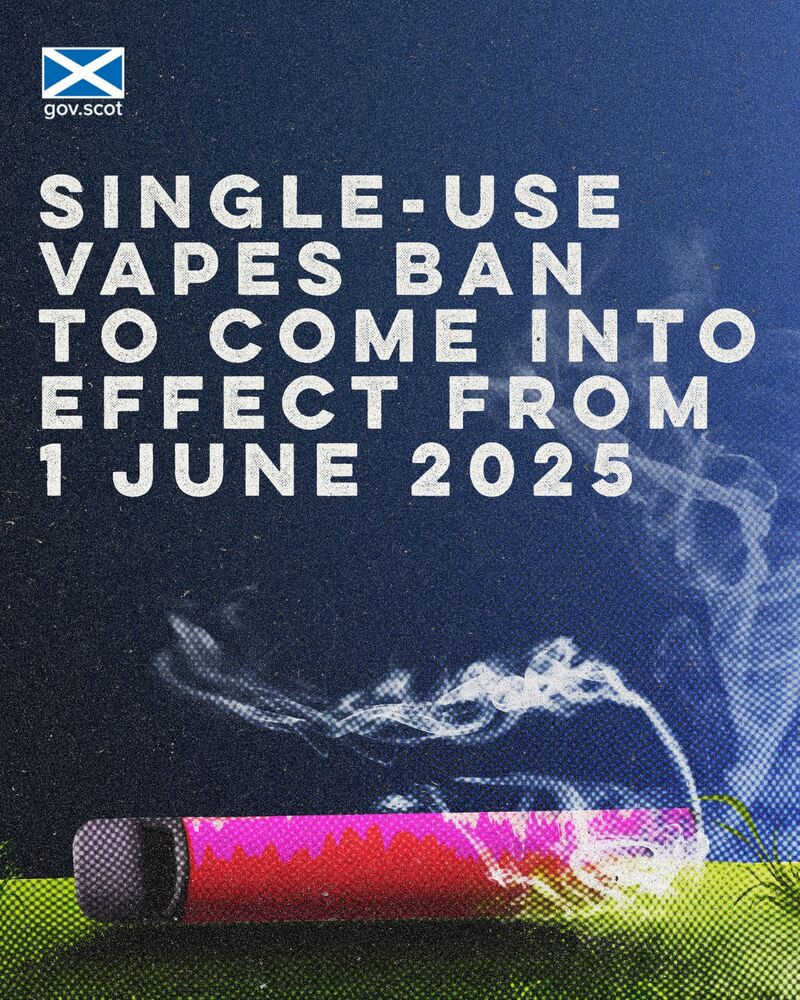
Single use vapes ban

From 1 June 2025, the sale and supply of single-use vapes will be banned across the UK.

The new regulations address the environmental and public health challenges posed by disposable vapes.

Businesses are encouraged to review their stock and prepare for these changes to ensure compliance with the law.

What the ban means

Under The Environmental Protection (Single-Use Vapes) (Scotland) Regulations 2024, a single-use vape is defined as a device that:

  • is not designed to be refilled
  • is not designed to be recharged, or
  • meets both criteria above

This ban applies to both in-store and online sales. It covers all products classified as single-use vapes.

Defra guidance

The Department for Environment, Food and Rural Affairs [Defra] has published guidance on:

  • practical steps to transition to compliant products
  • enforcement measures and potential penalties for non-compliance

Read the Single use vapes ban guidance.

What your business should do now

  • review stock and identify products that will no longer be sold legally
  • stop buying new stock of single-use vapes; sell through all existing stock
  • only buy vapes from reputable sources that follow the new regulations
  • train your employees about the new requirements and compliance expectations
  • arrange for the environmentally responsible disposal of any unsold single-use vapes

What your business should do from 1 June

From 1 June 2025, it is an offence to have disposable vaping products in your possession for sale. Any leftover disposable vaping products must be:

  • stored in stock rooms, away from the shop floor, and
  • separated from other goods, securely wrapped, and clearly labelled, they are waiting to be collected for disposal and are not for sale

Enforcement and penalties

Enforcement of the ban in Scotland will be carried out by local Trading Standards teams.

Businesses found in violation may face:

  • seizure of non-compliant products
  • fixed penalty notice
  • criminal prosecution with fines of up to £5000

Why this ban matters

Single-use vapes are difficult to recycle. They typically end up in landfills, where their batteries can leak harmful waste like battery acid, lithium, and mercury.

Batteries thrown into household waste also cause fires in bin lorries and waste-processing centres.

Defra estimates almost five million single-use vapes were either littered or thrown into general waste each week last year.

Isle of Lewis residents investigate mysterious sound

Islanders in the Outer Hebrides are reportedly being disturbed a mysterious low-frequency humming sound that can heard in the day and night. 

Around 200 people in Lewis have reported hearing the noise, which locals say is “impossible to ignore” and is louder nearer the coast of the island.   

Lauren-Grace Kirtley, who has set up a Facebook page dedicated to the noise which has been dubbed the “Hebridean Hum”, said the sound has prevented her from sleeping properly for several weeks. 

“It’s impossible to ignore – it is like somebody shouting in your face constantly for attention,” she told BBC Scotland.  

Marcus-Hazel McGowan, who has been using amateur radio techniques to try and find the source, also told the BBC: “It’s just trying to narrow it down and hoping nobody loses their mind completely over it.” 

Comhairle nan Eilean Siar said it had received reports relating to low-frequency sounds from a small number of islanders.  

A spokesperson for the local authority said: “As with any other reports of this nature, the comhairle’s environmental health team is investigating and will liaise with those who have reported issues.” 

Kirtley said the hum could be heard across Lewis and that it was less noticeable in the centre of the island and strongest on the east coast. 

She added that the Hebridean Hum had been recorded at a low frequency of 50hz. 

“It is a very low, humming, droning, pulsating noise. It’s incredibly intrusive and distressing,” she said.  

“I haven’t slept a night through for weeks and have problems concentrating. 

“I get a lot of fluttering in my ears. It’s making me dizzy and giving me headaches.” 

McGowan, who said he is determined to find the source of the mysterious hum, has ruled out SSEN’s Battery Point Power Station in Stornoway and also believes it was unlikely to be coming from boats. 

The power station on the island is only operated at certain times, while the hum has been reported as a constant problem.