REHIS President – January 2026 newsletter address

Dear REHIS members,

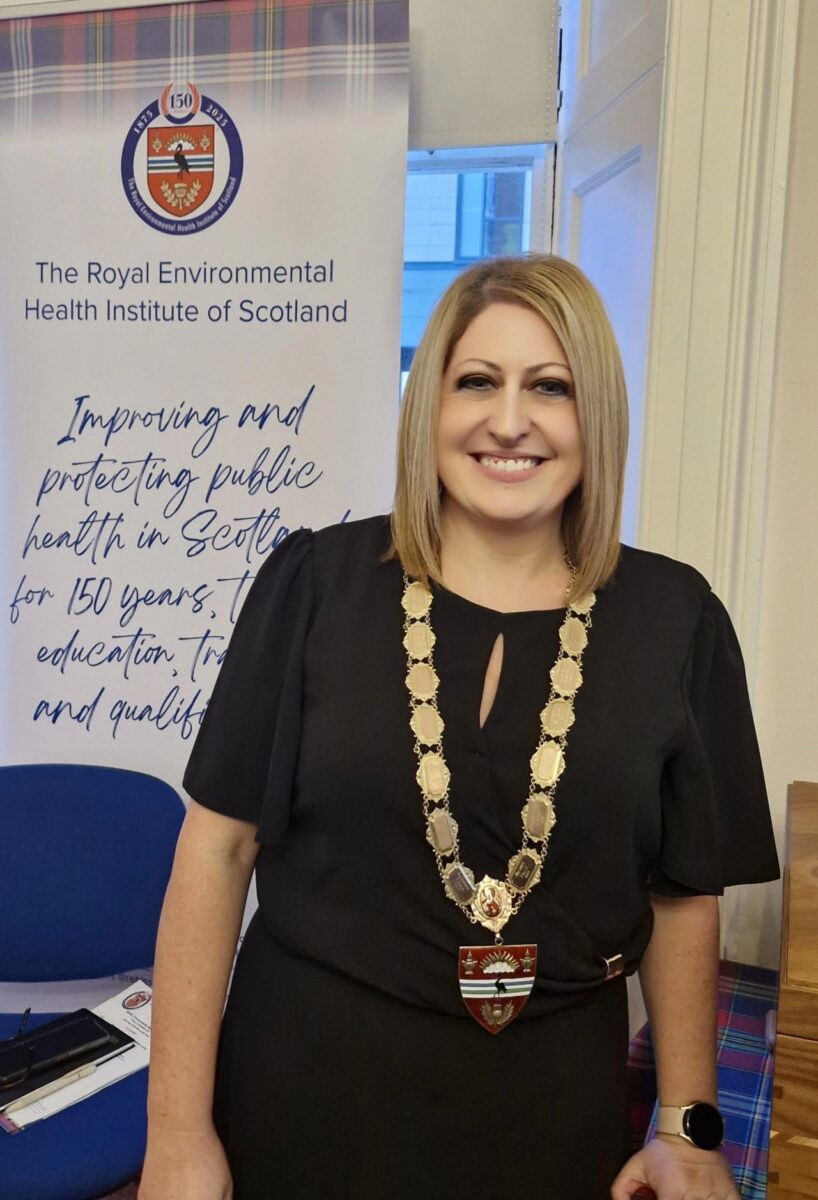
Thank you to everyone for welcoming me as your new President, it is a tremendous honour, and I am truly grateful for your ongoing support of our professional Institute. Rest assured, I will continue to work diligently to benefit our Institute and all of our members.

Following the successful celebrations of REHIS’ 150th Anniversary in 2025, which highlighted our proud history and achievements, we now look forward to building on that legacy as we enter a new year of progress and opportunity. As we look ahead, we recognise that 2026 will bring new challenges for the profession, yet as Environmental Health professionals, we carry essential knowledge, skills, and an enthusiastic spirit that uniquely position us to respond to these.

Some of the emerging challenges for the profession include the Climate Change Plan (2026-2040), which warns of more frequent extreme weather events and sets ambitious targets, to cut emissions and meet carbon reduction targets, reshaping how we live, travel, and heat our homes. Air quality remains a priority with a new framework replacing “Cleaner Air for Scotland 2” to tighten standards and tackle persistent health inequalities. Fuel poverty and poor housing conditions continue to drive respiratory and cardiovascular risks, and the introduction of Awaab’s Law for Scotland under the new Housing (Scotland) Act 2025 is a significant step forward. This law will require landlords to urgently investigate and address damp and mould within strict timeframes, improving standards for vulnerable households. Food safety regulation is also evolving, with new legislation and Food Standards Scotland’s 2026-2031 strategy focusing on authenticity, resilience, and healthy diets. These developments will demand proactive engagement from environmental health professionals to protect public health and promote sustainability as we go forward.

Our REHIS priorities this year include strengthening the Institute’s finances, preparing an updated Environmental Health Manifesto for Scotland, continuing to advance pathways into Environmental Health, engaging with our members, training centres, and stakeholders, updating our Royal Charter, and delivering our Strategic Plan.

Financial pressures remain a reality for everyone, and REHIS is no exception. Our ability to support the profession and promote Environmental Health depends on strong membership levels and income from our community training programmes. Both areas remain a priority, and work is ongoing to ensure they are sustainable in the longer term. Membership retention and growth are vital, and our Membership Action Plan is designed to strengthen these areas, but your continued support makes the biggest difference. Please help us by continuing to promote the benefits of REHIS membership to colleagues and I encourage you all to participate. Your input is always welcomed to help shape future offerings so please get in touch with any suggestions for CPD events, about anything we could do different and/or if you would like to get more involved.

I’m excited about what 2026 holds. Our evolving priorities and changing legislative landscape present us with immense opportunities to lead the way. With our expertise, proactive spirit, and united efforts, we can make a profound impact on the health of our communities and environment.

I look forward to the year ahead and working closely with our new Senior Vice President (John Murray) and Junior Vice President (Sandy Fowler), all of our Council members and REHIS staff. I hope to meet many of you at future REHIS events and Institute gatherings. Please feel free to share any ideas, feedback, or areas you would like me to champion.

Wishing every member a successful and rewarding 2026.

REHIS News – December 2025

Season’s Greetings
On behalf of everyone at REHIS, we wish you a Merry Christmas and best wishes for the New Year.  We thank you for your continued support and look forward to working with you again in 2026.  REHIS Merry CHRISTMAS

The REHIS office will close at 2pm on Wednesday 24 December 2024 and will re-open on Monday 5 January 2026. 

REHIS Lunchtime Seminar – 14 January 2026, 1215-1315  – FREE TO MEMBERS
The role of the Drinking Water Regulator and Private Water Supplies with Moira Malcolm and Jacqui Middleton  Free to Members – Lunchtime Training Events – January – REHIS

REHIS Southern Centre Event – 29 January 2026, 0930-1300
Traditional Housing Construction, Disrepair and Energy Improvement
Join John Gilbert Architects for an insightful half-day online training session focused on the construction, defects, and sustainable retrofit of traditional buildings. For more information REHIS Southern Centre – Traditional Housing Construction, Disrepair and Energy Improvement – REHIS

Environmental Health Scotland – the Journal
Special 150 Edition

Is now available in the Members section of the website. REHIS Journal – REHIS

Continuing Professional Development (CPD)
Participants of the Institute’s CPD Scheme, will be aware that CPD submissions for calendar year 2025 require to be with the Institute by 31 January 2026. The submission and the supporting evidence can be submitted online via the members section of the website.  For guidance on the updated CPD scheme, please refer here CPD – REHIS

South Lanarkshire butcher fined £1k after shop explosion which left man in intensive care

A butcher in Strathaven has been fined £1000 after an explosion and fire at her premises left a man with serious burns.

Ann Davidson breached health and safety legislation by storing a propane gas cylinder in the kitchen of her premises.

Hamilton Sheriff Court heard she and two men, aged 69 and 58, fled as flames engulfed the building on August 11, 2022.

Richard Brown, prosecuting, said the older man suffered burns to his face, head, hands and back. He was in intensive care in hospital for two weeks and underwent surgery and skin grafts.

Mr Brown told the court: “He also suffered a stroke and developed sepsis. He was in hospital until January 2023 when he went into a care home. He is likely to stay there for the rest of his life. “It’s thought the severe injury sustained in the fire was a significant factor in bringing about his stroke.”

The 58-year-old was treated for minor burns while Davidson suffered burns to her hands and permanent hair loss.

Davidson, 51, of Blackburn Farm, Chapelton, admitted failing to store the gas cylinder safely.

The court was told she and the two men were working late in the evening when the explosion happened. Davidson and the 58-year-old left the shop for a short time and when they returned they heard a “hissing sound” from the kitchen. This was followed immediately by a blast.

Mr Brown said: “On hearing the explosion, customers emerged from a nearby pub to assist. Residents living above the shop were evacuated.“Numerous fire appliances attended and firefighters worked for several hours to bring the blaze under control.”

The fire was caused by gas escaping and igniting after the cylinder valve was opened.

Mr Brown added: “The cylinder should have been stored outside or in a properly ventilated area, but not in the kitchen.”

Davidson did not attend court for the hearing. Her lawyer, Vikki Watt, produced a doctor’s letter explaining that she still suffers “physical and psychological effects” following the blaze.

She stated: “My client offers her sincere apologies and appreciates the catastrophic consequences for [the older man] who was a family friend.

“She was aware of the requirement to be careful over the storage of the gas cylinder, but felt it was safer in the kitchen than outside where the general public would have access to it.”

The solicitor described Davidson as a “hard-working and dedicated” person who is “well-respected and active in the community”.

The Strathaven shop has not reopened since the fire but she now runs a shop in Bridge of Allan, near Stirling.

Sheriff Linda Nicolson described what happened as “extremely unfortunate” but accepted it was an “isolated” incident.

Davidson was given three months to pay the fine.

Serious Listeria infections rising in Europe, EU report warns

Changing diets and an ageing population may be contributing to a rise in serious Listeria infections across Europe, according to the new EU One Health Zoonoses Report from the European Food Safety Authority (EFSA) and the European Centre for Disease Prevention and Control (ECDC).

In 2024, Listeria caused the highest proportion of hospitalisations and deaths among all foodborne infections reported in the European Union (EU). About 7 in 10 people infected with Listeria needed hospital care, and 1 in 12 people died.

The upward trend of infections seen in recent years may reflect several factors, including Europe’s ageing population, changing eating habits – such as the increasing consumption of RTE foods – as well as improper food handling and storage practices.

For RTE foods, contamination levels remain very low across most categories: the latest data onListeria monocytogenes show that the proportion of samples exceeding the EU food safety limits ranged from 0% to 3% across all products analysed, with fermented sausages being the most frequently contaminated products.

“Even though contamination is rare, Listeria can cause severe illness, which makes it one of the most serious foodborne threats we monitor,” said Ole Heuer, Head of ECDC’s One Health Related Diseases Unit. “Protecting vulnerable groups, such as older adults, pregnant women or those with weakened immune systems, requires strong surveillance, safe food production and key precautions at home.” 

While Listeria poses the greatest risk of severe illness, Campylobacter and Salmonella remain the most common causes of foodborne illness in Europe, with poultry meat and eggs being important sources of infection.

Recent data in the animal sector also show significant increase over the past decade in the number of breeding chickens and turkey flocks testing positive for Salmonella. Controlling these bacteria in the food chain remains essential to reducing human cases:

Enhanced surveillance tools, such as whole genome sequencing, allow authorities to detect and investigate outbreaks more effectively, supporting coordinated actions across the food chain.

Incineration in Scotland has increased by 354% since 2011

Environmental Standards Scotland (ESS) is calling for urgent action to prevent an overcapacity of waste incineration that campaigners warn threatens climate goals, public health and the circular economy.

ESS has reached agreement with the Scottish Government on a series of actions that will bring clarity over Scotland’s future incineration capacity needs and ensure that consideration is given to them when determining applications for increasing incineration capacity in Scotland.

Together these actions will help ensure that Scotland does not become overly reliant on incineration as a means of waste management, known in the industry as, ‘incineration lock-in.’

While incineration is considered to have a lower climate impact than landfill, there is a concern that unregulated growth of the industry poses a risk to public health, threatens to undermine preferable waste management options such as recycling, and could hamper Scotland’s net zero ambitions.

More than 1.86 million tonnes of waste was burned in Scotland in 2024, an increase of 354% from 2011. The shift towards increased incineration has resulted in the construction of new incineration facilities. As of 2024, 18 permitted incineration sites were operating in Scotland. In addition, the available capacity at an existing facility has also increased. For example, in 2023, the waste facility in Dunbar expanded its capacity by 65,000 tonnes.

ESS undertook an investigation following concerns raised that the Scottish Government had failed to implement a key recommendation from a 2022 independent review of incineration. This recommendation concerned the development of an indicative residual waste management cap intended to prevent long-term incineration overcapacity and support Scotland’s transition to a circular economy. Although the Scottish Government accepted this recommendation at the time, it was never implemented.

Concerns had also been raised to ESS that the Scottish Government had failed to control incineration capacity effectively.

A new report published by ESS, “The effectiveness of the Scottish Government’s Implementation and Application of Environmental Law in relation to Incineration Capacity in Scotland”, outlines the measures the Scottish Government has agreed to implement in response to the concerns raised by ESS’ investigation.

These measures include commitments to:

  • publish an updated forecast of incineration capacity in Scotland
  • develop an indicative residual waste treatment cap through the forthcoming Residual Waste Plan (due in 2027)
  • integrate the national indicative cap into the Scottish Environment Protection Agency’s permitting framework, ensuring that national capacity is considered when assessing all environmental authorisation applications for capacity changes

Mark Roberts, Chief Executive of ESS, said: “While well-regulated incineration has a role in managing unavoidable residual waste, we must prevent the potential harm caused from over-reliance on this method of waste management.

“The Scottish Government’s commitment to develop an indicative cap and ensuring this is reflected in SEPA’s permitting regulations, will provide a strategic benchmark for decision making, reinforce the objectives of the waste hierarchy and prevent overcapacity that could undermine wider recycling and waste reduction efforts.

“We will continue to monitor the implementation of the new measures and provide updates to the public on progress.”

Finding new owners for empty homes

A new online portal (Matchmaker Scheme for Empty Homes in Scotland – Scotland Empty Homes Partnership)has been launched to bring empty homeowners together with prospective buyers or developers with the aim of facilitating more properties to be used as homes again. 

Covering the whole of Scotland, this builds on the success of local pilots, referred to as “matchmaker schemes”, which allow owners of empty homes to upload details of their properties to a website through which anyone, such as first time buyers, families, developers or local authorities, can make purchasing enquiries.   

The portal is hosted by the Scottish Empty Homes Partnership and has been developed as part of a £2 million investment this year to recruit additional empty homes officers and fund initiatives that will accelerate the pace and numbers of empty homes that are brought back into use.  

Properties can be listed free of charge.  

Local schemes currently exist in Aberdeenshire, the Borders, Fife, East Lothian, Argyll and Bute, Orkney and South Ayrshire. The majority will wind down their schemes in place of this new national portal. Aberdeen City will continue their local scheme.  

Housing Secretary Màiri McAllan said: 

“If you have an empty home to sell, this new portal is for you.

“Making best use of existing housing stock is central to tackling the housing emergency. Bringing owners and buyers together is a great way of adding to the overall housing supply, be that for affordable housing or use on the private market and it complements our ambitious house building programme.

“We are already making progress in turning around empty properties. Over the past 15 years we have helped return almost 13,000 privately owned homes to use and last year we saw 2,066 homes brought back in a single year, the highest in a year to date.  

“I would encourage anyone who has a home lying empty to use this new scheme and seek advice from the Scottish Empty Homes Partnership and their local council to bring their home back into use.” 

Tahmina Nizam, Scottish Empty Homes Partnership National Manager, said: 

“Every home matters in our collective fight against the housing emergency, so we’re delighted to launch this brand-new matchmaker scheme. 

“We know selling an empty home can be a daunting task; the matchmaker scheme is designed to make that process easier and to help get more homes back into productive use. 

“We want anyone who owns an empty home to know that support is available, either from the network of dedicated local empty homes officers working in local authorities across the country or directly from the Scottish Empty Homes Partnership. 

“No home was built to sit empty and it’s vital that we make the best possible use of the assets we already have. Every individual empty property could provide a safe and secure place for someone to call home, but collectively Scotland’s empty homes can make a huge contribution to ending the housing emergency.” 

Sustainable alternative to cremation

Environmentally-friendly hydrolysis, also known as water cremation, will be introduced under draft regulations laid in the Scottish Parliament.

The regulations will, if approved, give an option for people interested in alternatives to burial or cremation for the first time in more than a century.

Through this process, the body is wrapped in a silk or woollen shroud, or other biodegradable material, before being placed in a chamber with hot water and chemicals, speeding up decomposition. Remains can be returned to next of kin, similarly to ashes following cremation.

International evidence suggests hydrolysis is more sustainable than traditional cremation, which uses large amounts of natural gas.

The Scottish Government consulted on the issue in 2023, with 84% of those who responded supporting the introduction of hydrolysis.

Public Health Minister Jenni Minto said:

“We are introducing these regulations today following extensive consultation which has shown significant public support for the introduction of new, environmentally-friendly alternatives to burial or cremation. This included hydrolysis – which is already in use in some countries including Ireland, Canada and the USA.

“These regulations, if passed by Parliament, will give an option for people interested in alternatives to burial or cremation for the first time in more than 100 years. We are not suggesting hydrolysis replaces or displaces traditional methods of burial or cremation in any way. It is a matter of individual choice, but it is important that we ensure bereaved families and friends can have confidence in the care and dignity given to their loved ones when they pass.”

Planning for healthier communities: opportunities in the Scottish planning system

In collaboration with Public Health Scotland, Nesta, an innovation agency for social good, has published two key publications which explore how Scotland’s planning system can be used to create healthier food environments and support efforts to reduce obesity and health inequalities.

The two publications are:

These resources draw on research, stakeholder engagement, and lessons learned to recommend practical steps for integrating food environment policies into the local planning system.

Around two thirds of adults in Scotland are living with overweight or obesity, and one in three children starting primary 1 are at risk of overweight or obesity, with rates significantly higher in more deprived areas. Recent modelling also projects substantial increases in overweight by 2040. The need for change is evident and reducing overweight and obesity is a key priority in Scotland’s Population Health Framework.

Historically, planning policies in Scotland have rarely addressed food environments or obesity directly.  But now, the Scottish Government’s National Planning Framework 4 (NPF4) and Local Development Plans (LDPs) provide an opportunity to change that. LDPs are currently in preparation stage, with decisions taken over the next two to three years shaping Scotland’s food environment for the next decade.

Many organisations, including local authorities and health boards, play a key role in the planning process. These new publications outline key stages and priority areas where public health professionals can contribute and influence the development of plans, such as:

  • providing local health data and expertise to support the case for food environment policies
  • focussing on health inequalities and areas where unhealthy food environments and obesity rates are highest
  • building stronger collaborations between planning and public health to gather evidence and advocate for change

Claire Hislop RNutr (Public Health), Organisational Lead – Food and Physical Activity, Public Health Scotland, said:

“Scotland’s current food environment often fails to support healthy eating. This is particularly evident in communities with higher deprivation and where access to affordable, nutritious food can be limited.

“Improving Scotland’s food environment requires a package of measures; utilising the planning process as part of this is both necessary and possible.

“In particular, Local Development Plan preparation offers a unique, but time limited, opportunity to contribute to creating communities that enable and promote healthier food options – for years to come.”

Frances Bain, Mission Manager, Nesta, added:

“Nesta were delighted to partner with Public Health Scotland on this research which was carried out through a residency placement and explored the potential to use the planning system to influence healthier food environments.

“Thanks to all the local and national stakeholders who participated in the research and in particular Dr Meadhbh Maguire for leading the work.

“We have been able to outline the opportunities and challenges that exist when considering new planning policies relating to the food environment and highlight the role that local development plans can play in supporting public health.”

EU publishes annual report on food trade platform

The annual report of a system that helps ensure safe trade involving Europe has revealed the scale and reasons for rejected shipments.

TRACES is the online platform of the Directorate-General for Health and Food Safety (DG Sante) in the European Commission, used for sanitary, phytosanitary and food safety certification. 2024 marked the system’s 20th anniversary.

It supports the importation of animals, animal products, food and feed of non-animal origin and plants and plant products into the European Union; some intra-EU trade, and EU exports of animals, certain animal products,and plants.

Out of 5.4 million official documents and certificates issued in and sent to TRACES, about 65 percent were issued in electronic format. According to DG Sante, the system is an essential tool in the fight against fraudulent certificates and illicit trade.

Authorities can apply an electronic seal on official documents and certificates. This reduces the risk of fraudulent certificates being issued, simplifies the certification process and makes it easier to carry out and record official checks.

TRACES consists of several modules covering a range of sanitary and phytosanitary (SPS) certificates and documents that are required with imported products.

Data on the module for movements of animals, animal by-products and some products of animal origin show almost 792,000 certificates were issued and 59 percent were e-signed. More than 122,000 consignments were checked on route or at destination.

In 2024, there were 5,800 reported cases of non-compliance with animal health rules and 1,929 breaches of animal welfare rules.

Under the Official Controls Regulation, a Common Health Entry Document (CHED) is required to record the findings of official checks on relevant consignments of animals and goods entering the EU.

CHED-P covers products of animal origin, animal by-products and derived products, and composite products. Most of them are issued for shipments of fishery products, meat, animal feed, and milk.

From more than 14,000 rejections, the main reasons for refusal of entry into the EU of such products were documentary and certification issues. Other problems included hygiene or temperature failures, a cold chain breakdown, and non-approved countries.

CHED-D is for consignments of food and feed of non-animal origin and food contact material. Most of them are for consignments of fruits, nuts and vegetables.

From more than 3,200 rejections, the main problem was chemical contamination. Other violations included fraudulent certificates, microbial contamination, or hygiene concerns.

“The steady annual increase in the number of official documents issued in TRACES (up by 8.5 percent from 2023) is a clear indicator of the platform’s central role in enabling trade in animals and products across borders, facilitating not just the movement of those goods, but also improving their safety, compliance and traceability,” said Sandra Gallina, director general for health and food safety.

Scottish Government consult on noise action plans covering five cities

The Scottish Government are consulting on an updated Agglomeration Noise Action Plan.  

This consultation applies to the draft Agglomerations Noise Action Plan for Scotland that covers the five agglomerations of Aberdeen, Dundee, Edinburgh, Falkirk, and Glasgow, and seeks the views of those individuals and / or organisations that hold an interest in noise pollution.

The Environmental Noise (Scotland) Regulations 2006 (“the 2006 Regulations”) requires the Scottish Government to bring about measures which are intended to avoid, prevent, or reduce, on a prioritised area basis, the harmful effects, including annoyance due to the exposure to environmental noise.

Agglomerations are defined by regulation as urbanised areas with at least 100,000 inhabitants and a population density equal to or greater than 500 people per km2.

Read the consultation paper. This consultation is open until December 31st.

Also, noise exposure levels are to be mapped within agglomeration boundaries and information made available to the public.

Agglomerations Noise Action Plan for Scotland – Scottish Government consultations – Citizen Space

Draft Climate Change Plan published

The Scottish Government have published their draft Climate Change Plan to 2040. The plan sets out actions designed to reduce Scotland’s greenhouse gas emissions.

Scotland is already over half way to net zero having reduced emissions by 51.3% since 1990 – the largest reduction in the UK and faster than the EU average, using comparable statistics.

The new plan details over 150 policies and proposals building on this progress, including:

  • setting a target to decarbonise building heat systems by 2045
  • phasing out new diesel and petrol cars by 2030
  • increasing woodland creation so that by 2029/30 18,000 hectares are planted every year, with 21% woodland cover in Scotland by 2032
  • increasing peatland restoration by 10% each year to 2030

The independent Climate Change Committee has emphasised the necessity for shared delivery and collaboration between national governments given between 30-60% of the emissions reduction required in Scotland, Wales, and Northern Ireland will be in areas of policy that are mostly reserved.

A consultation on the proposals will run until the new year.

Climate Action Secretary Gillian Martin said: “Raising awareness of climate action has never been so important, with communities across Scotland and around the world already being affected – through flooding, heatwaves and wildfires.

“This draft plan includes over 150 actions across sectors such as transport, heat in buildings and agriculture that are key to achieving Scotland’s net zero goal while supporting people to make and adjust to the changes required.

“It also describes how we will seize and fairly distribute the opportunities from the transition to net zero – from new jobs, inclusive growth and better infrastructure to improved public services and healthier people – thanks to cleaner air, warmer homes and wealthier communities.

“The plan does not ask the impossible of people. We will not sacrifice people’s health or wealth. 

“Through this consultation, everyone has a voice in shaping the final plan to inform future decision making and ensure that we reach our net zero in a way that is fair, ambitious and capable of rising to the emergency before us.”

A consultation on the Plan will run until 29 January 2026

Stopping non-essential wood burning could save NHS over £54m annually

The new research, commissioned by Global Action Plan and Hertfordshire County Council, finds that air pollution from domestic combustion contributes to nearly 2,500 deaths each year in the UK. Across the population, this adds up to over 27,000 years of life lost to early deaths. The report, produced by air quality and economic experts at world-leading environmental consultancy Ricardo, also suggests that air pollution from burning in the home contributes to new cases of a range of serious health conditions, including an average of 3,741 cases of diabetes and 1,493 cases of asthma in the UK each year.

Larissa Lockwood, Director of Policy & Campaigns at Global Action Plan – the charity behind Clean Air Night – said: “We all need to stay warm this winter, and we also need to think about the health impacts of our heating choices. An open fire or wood burning stove is the most polluting way to heat a home – air pollution from wood burning stoves is cutting lives short, putting people in hospital, and contributing to serious health conditions for people across the UK.

“It’s an uncomfortable fact, but the health burden of wood burning on the British public is simply too big to ignore. Existing measures to curb wood burning emissions are not tackling the burning problem at hand. The UK Government must take action to ensure everyone can access cleaner, greener and more affordable heating – including ensuring homes are properly insulated – as well as strengthening powers to allow local authorities to tackle air pollution, and providing clear guidance for the public on the health harms of burning wood and other solid fuels in our homes.”

Clean Air Night (22 January 2026) is brought to you by Global Action Plan with funder Impact on Urban Health.