An interactive map showing information about publicly-owned land, as well as land managed by Scottish Crown Estate, has been created.
The public land map allows anyone to view the location and range of much of the public land in Scotland. Users can explore information on individual land parcels, including its ownership and size.
The information has been brought together as a searchable map for the first time to include land managed by Crown Estate Scotland and the four main landowning public bodies in Scotland; Forestry and Land Scotland, NatureScot, Scottish Water and the Scottish Ministers Crofting and Farming Estate.
Public and Scottish Crown Estate managed land makes up 11% of Scotland – equivalent to around 857,000 hectares – making it a vital national asset in tackling the twin crises of climate change and biodiversity loss.
Rural Affairs and Land Reform Secretary Mairi Gougeon said:
“I would like to thank all of our partners who have helped develop this resource that will allow people to explore the range of public or Scottish Crown Estate land in Scotland. Given the scale of it, at more than 10% of Scotland, this land provides us with opportunities for increasing opportunities for agriculture, woodland creation and peatland restoration, which in tandem with the existing capacity for timber production and renewable energy generation, are crucial to reducing our emissions.
“This is a significant demonstration of our commitment to providing transparency of public land ownership in Scotland.”
Ronan O’Hara, Chief Executive of Crown Estate Scotland, said:
“Crown Estate Scotland’s land and assets – which are held in trust for the people of Scotland – represent both a crucial resource and a key part of the country’s natural landscape.
“Crown Estate Scotland wants these assets to be used for the long-term benefit of the people of Scotland and we are delighted to be as open and transparent about those assets as possible. This is to make sure people know what is being held on their behalf and what we are doing to protect those assets for the long term.”
The Institute’s Annual General Meeting was held on Friday 22 November at the COSLA Conference Centre in Edinburgh with a good turnout from members, some in person and others online. Lynn Crothers gave her Presidential Report reflecting on the previous year in her role as President with Martin Henry, Honorary Treasurer giving the financial update.
Alan Morrison has now been installed as the Institute’s President for the coming year. Congratulations to Alan and all the newly elected Members of the Council. You can view the Council Members here. MEMBERS OF THE COUNCIL – REHIS
Martin Henry and Lynn Crothers
Alan Morrison, President
Prior to the AGM was the Institute’s annual Environmental Health Update where we heard from an excellent line up of speakers including Dr Margaret Douglas of Public Health Scotland speaking about Transport Poverty and Dr Maria Rossi speaking about “Developing a Population Health Framework for Scotland”. The presentations from the event will soon be available on the REHIS Members area.
REHIS Annual Environmental Public Health and Housing Update, 27 November 2024
The annual Public Health and Housing update event is being held on 27 November. Presenters include Dr Tim Everett speaking on the Effectiveness of Statutory Nuisance, Jim Wilson from Scottish Government speaking on Responsible Dog ownership, Dr Neil Cunningham speaking on the Impact of Climate Change on Public Health, Food & Security and also Robin Mitchell speaking on Cryptosporidium and Swimming Pools. To book a place please click hereEnvironmental Public Health & Housing Update – REHIS
Coming soon – Investigative Interview Training, 28, 29 and 30 January 2025
The Institute is hosting an ‘Investigative Interview Training’ course in January, to be held in Stirling, which is being delivered jointly by George Barnsley and Applied Theatre. More information on this event will be out very soon.
Royal Society for the Prevention of Accidents (RoSPA) new report, Safer Lives, Stronger Nation, shows that as well as the tragic human loss, preventable accidents cost the UK a massive £12 billion every year due to lost working days and medical care.
Accidental deaths in the UK have reached an all-time high, with the rate increasing by 42% over the last decade, making them the second biggest killer of people under 40.
RoSPA is now calling on the Government to implement a National Accident Prevention Strategy to save lives, boost the economy and free up capacity in the NHS.
RoSPA’s report reveals that you are substantially more likely to suffer a serious accident today than you were 20 years ago. The rate of accidental deaths in the UK has increased by 42% in the last decade: accidents now take over 20,000 lives each year, which is more than the capacity of London’s O2 arena.
Accidental deaths have risen in Scotland (up 57%), England (up 40%), Wales (up 41%) and Northern Ireland (up 56%) since 2013. Accidents are the second biggest killer of people under 40 (after intentional injuries) and the most common cause of preventable death in children under 15.
Number of accidental deaths in 2022
% rise in accidental deaths since 2013
Rate of accidental death per 100,000 people
UK-wide
21,336
42% increase
32 deaths
England
16,765
40% increase
29 deaths
Scotland
2,677
57% increase
49 deaths
Wales
1,206
41% increase
39 deaths
Northern Ireland
688
56% increase
36 deaths
New data from all four nations, collated by RoSPA, reveals that almost half (46%) of all accidental deaths (over 9,700 people) in 2022 resulted from falls. Over a quarter (26%) resulted from poisonings and 7% were because of a road traffic accident or transport related. Falls also accounted for nearly two thirds (61%) of all accident-related hospital admissions (almost 450,000 instances).
Accidents from crushing, striking, powered hand tools and machinery (known medically as ‘exposure to inanimate mechanical forces’) accounted for over one in 10 (12%) of all accident-related hospital admissions, and 7% were because of a road traffic accident or transport related.
New data from all four nations, collated by RoSPA, reveals that almost half (46%) of all accidental deaths (over 9,700 people) in 2022 resulted from falls. Over a quarter (26%) resulted from poisonings and 7% were because of a road traffic accident or transport related. Falls also accounted for nearly two thirds (61%) of all accident-related hospital admissions (almost 450,000 instances).
Accidents from crushing, striking, powered hand tools and machinery (known medically as ‘exposure to inanimate mechanical forces’) accounted for over one in 10 (12%) of all accident-related hospital admissions, and 7% were because of a road traffic accident or transport related.
Most common cause of accidental death in 2022 (UK wide)
1. Falls – 46% 90% increase in the last decade
2. Poisonings – 26% 96% increase in the last decade
3. Other – 13%
4. Road traffic / transport – 7% 17% decrease in the last decade
5. Threats to breathing e.g. choking and suffocating – 3% 17% increase in the last decade
6. Drowning – 1% 13% increase in the last decade
Becky Hickman, Chief Executive at RoSPA, said: “The UK is facing an accident crisis. We are all substantially more likely to suffer a serious accident today than we were 20 years ago. We must take action now to stop further preventable deaths and serious injuries – accidents are avoidable and do not need to happen. Even those who have never been involved in an accident are still suffering, as increasing numbers of accidents are choking the UK economy and engulfing the NHS – taking up bed space, money, time and resources that could be directed to other serious illnesses.
“Our new report revealing the growing numbers and types of fatal and life-changing accidents across the UK unveils a new public health scandal. By implementing a National Accident Prevention Strategy to sit across government departments problems can be tackled at their core, with a joined-up approach to cover all types of accidents – whether they happen at home, on the road, at work or in public. For too long we have accepted the economic and social consequences of accidents, and we’re still paying the price. We are calling for a National Accident Prevention Strategy to make the UK a safer place to live.”
Dan Evans, Chief Executive at Speedy Hire who are partnering RoSPA in this campaign, said: “We take health and safety extremely seriously, and it is a source of immense pride that we have been recognised for our excellence in keeping colleagues and customers safe. For us, colleague safety doesn’t begin and end at the workplace door, which is why at Speedy Hire we take a ‘whole person, whole life’ approach. This has never been more important to do so, as RoSPA’s report reveals people are far more likely to suffer a serious accident at home than they are at work. Both the cost of accidents to peoples’ personal lives and to businesses is far too high, so we must act now to keep people safe and support economic growth.”
RoSPA is calling for the Government to seize the initiative and create a National Accident Prevention Strategy – a first for the UK. And, because it’s impossible to arrest a crisis like this without a plan, RoSPA proposes that the National Accident Prevention Strategy is the specific responsibility of an individual minister without a portfolio. This would enable the minister to treat accident prevention holistically, with the authority to attend the Cabinet and the ability to convene cross-departmental committees.
The National Accident Prevention Strategy must:
Take a joined-up approach which cuts across departments and provides strategic leadership to guide policy making at national level
Empower individual departments or agencies to craft and implement more detailed policies
Propose ambitious and evidence-led but realistic policy interventions to reduce accident rates
Cover the core sectors directly affecting the UK economy: home, work, product, leisure and transport
Be forward-facing to address emerging challenges, like the climate crisis, the rise of AI and the UK’s ageing population
Address inequalities like deprivation, age, ethnicity and region
Take a four-nations approach to data sharing and collaboration
Strengthen Government’s data collection and publishing processes relating to accidents.
Latest figures, published by Public Health Scotland (PHS) on 21 November, show laboratory reports of norovirus in Scotland have increased in recent weeks. Norovirus cases are known to peak in winter and so can be expected to rise over the season.
Public Health Scotland received 1629 laboratory reports for norovirus in Scotland up to the end of week 45 (week ending 17 November 2024), compared to 1,563 the previous week.
Norovirus is a common illness that can cause diarrhoea and vomiting. It can be very unpleasant, but most people make a full recovery within a couple of days.
The most effective way of helping to protect yourself from winter bugs, including norovirus, is to wash your hands thoroughly with soap and water. Handwashing with soap and water is best, as alcohol hand gels are not effective against norovirus. By keeping hands clean and encouraging children to practise good hand hygiene as well, we can significantly reduce the transmission of infections.
It is also important to minimise contact with others if you have norovirus. If you or your child have diarrhoea and vomiting, stay away from work, school or nursery until 48 hours after symptoms have stopped, and don’t prepare food for others in that time either.
The bill includes measures to create a smoke-free generation, phasing out the sale of tobacco products across the UK to anyone aged 15 or younger this year, breaking the cycle of addiction and disadvantage.
In addition, the UK Government will be given powers to extend the indoor smoking ban to specific outdoor spaces – with children’s playgrounds and outside schools and hospitals all being considered, subject to consultation.
The measures announced include:
Rising age of sale for tobacco applying to anyone aged 15 or younger in 2024, intended to phase out the sale of tobacco at retail;
Powers to extend indoor smoking ban to include certain outdoor areas with a focus on protecting children and those who are vulnerable (schools, playgrounds and hospitals mentioned), subject to consultation;
Subject to consultation, the government is also considering extending restrictions in places that are currently smoke free to also become vape free, especially in areas where there are children and young adults.
A ban in the Bill on vape advertising and sponsorship, plus powers to restrict the flavours, display and packaging of all types of vapes as well as other nicotine products;
Introduce new fixed penalty on the spot fines for retailers breaching regulations;
Scottish Health Minister Jenni Minto welcomed the announcement, adding:
The Scottish Government agreed along with the other two devolved administrations and the UK Government to support a Tobacco and Vapes Bill following a 2023 public consultation. Smoking in indoor spaces and near hospitals is already banned, but the Bill proposes extending those measures to help achieve a tobacco-free Scotland by 2034. It will also require all businesses selling nicotine and herbal smoking products to join the existing register of tobacco and nicotine vapour retailers.
Argyll and Bute Council create Youtube video on what it’s like to work as an Environmental Health Officer for Argyll and Bute Council.
The video features Cameron McAuley, Chartered Environmental Health Officer taking you through day in life on an Environmental Health Officer and the vital work of the role to protect public health.
The latest Radioactivity in Food and the Environment Report (RIFE 29) has been publishedand shows that levels and concentrations of man-made radioactivity measured in the environment during 2023 were well within international dose limits.
The annual RIFE report is a joint publication between all six agencies across the UK responsible for ensuring that doses from authorised releases of radioactivity remain within strict international limits. It brings together all results from SEPA, the Environment Agency, Food Standards Agency, Food Standards Scotland, Natural Resources Wales, and the Northern Ireland Environment Agency.
RIFE monitors radioactivity levels in food, water and the environment, assessing any potential impact on human health. The findings confirm that radiation doses to the public are well below harmful levels and largely originate from natural sources such as cosmic rays and radon.
Monitoring confirms that the highest dose for a member of the public in Scotland was approximately 2% of the legal limit 0.021mSv. This compares to a UK average radiation exposure from all sources of 2.7mSv – of which 84% is due to natural background sources.
Radioactivity occurs naturally in the earth’s crust and it can be found in the food we eat, the water we drink and the air we breathe. Exposure to man-made radioactivity includes medical procedures and treatments, and discharges from nuclear and non-nuclear establishments.
The average individual dose from medical sources was about 16% of the dose from all sources of radiation.
Occupational exposure contributed significantly less than 1% of the dose.
Around 0.2% of the annual dose was from man-made sources – the majority from radionuclides released during historical testing of nuclear weapons in the atmosphere from the 1950s and 1960.
Exposure to radionuclides routinely discharged by industry contributing less than 0.01% to the total dose.
Wood-burning stoves, bioenergy and peat heating will now be permitted in new homes and buildings following a review of the New Build Heat Standard commissioned by ministers earlier this year.
An amendment to regulations made today permits the installation of bioenergy and peat main heating systems – and any type of secondary heating systems – in new buildings from 1 January 2025, while maintaining the prohibition on mains gas and oil boilers as a main heating system.
Alasdair Allan, Acting Minister for Climate Action said:
“The New Build Heat Standard is crucial to help reduce emissions from new buildings, preventing the need for retrofit in the future and ensuring a cleaner and greener Scotland.
“Heat from our homes and buildings makes up almost a fifth of Scotland’s carbon emissions so we must tackle the most polluting forms of domestic heating to reach net zero.
“We have listened to concerns from rural and island communities about resilience in times of bad weather or power outages, as well as the wider use of bioenergy and peat for other reasons. These changes address these concerns whilst retaining the spirit of the original legislation, which aims to eradicate polluting gas and oil boilers from new homes and buildings.
“I would like to thank all of those who submitted evidence and views, particularly those from rural and island communities – their input has been vital in delivering his positive outcome.”
Luke Fraser, Vice Chair of the Scottish Islands Federation said:
‘The Scottish Islands Federation is delighted that the points raised by our members and others, as part of the review of the New Build Heat Standard, have been taken into account. We believe there is a need to help sustain and support the resilience of households in rural and island communities through the use of wood burning stoves and burning of peat, and the changes to the NBHS announced today have taken this on board.
“While we are in support of the need for climate action, progress must be made in tandem with developing and enhancing the resilience and sustainability of our communities, not at their expense. This change is a positive step in that direction.’
The Scottish Government consulted on proposals for the New Build Heat Standard in 2021 and again in 2022, and also carried out a series of impact assessments which have been updated as part of the review, as required.
Under the original regulations, which came into force in April this year, wood burning stoves were only permitted in new homes and buildings for emergency heating.
Ministers introduced a temporary direction in September 2024 which reverted the regulations to the pre-April 2024 situation in relation to bioenergy and peat systems in new homes only, pending the conclusion of this review. These interim provisions remain in place until 1 January.
The Scottish Health Survey 2023 results, published this month, provide information on the health, and factors relating to health, of adults and children in Scotland.
Almost a third of adults (32%) were living with obesity, the highest level recorded and an increase from 24% in 2003.
Over a fifth of younger adults were using e-cigarettes or vaping. Twelve per cent of adults were current e-cigarette or vaping device users, an increase from 10% in 2022. The proportion was highest for adults aged 16-24 (22%).
Fourteen per cent of adults reported experiencing food insecurity, an increase from 9% in 2021 and the highest level since the time series began in 2017.
Drinking at hazardous or harmful levels continued to decrease,from 34% of adults in 2003 to 20% in 2023. The proportion of males that drank to hazardous or harmful levels was twice as high as for females (28% and 14% respectively).
Mental wellbeing and mental ill health returned to similar levels to those reported in 2021, following an increase in 2022. Average Warwick-Edinburgh Mental Wellbeing (WEMWBS) scores for adults increased to 48.9, up from 47.0 in 2022 and 48.6 in 2021. The proportion of adults with a GHQ-12 score of 4 or more (21%), indicative of a possible psychiatric disorder, returned to a similar level to 2021 (22%) following an increase to 27% in 2022.
Other key findings show that in 2023:
One in ten adults (10%) reported feeling lonely ‘most’ or ‘all of the time’, similar to the level reported in 2022 (11%). Adults aged 16-24 (19%) and those living in the most deprived areas (14%) were the most likely to report feeling like this in the past week.
Adult prevalence of limiting long-term conditions was 38%, similar to 2022 (37%) and continuing the general upward trend.
Prevalence of any CVD (excluding diabetes or high blood pressure) remained at 15% of adults.
More than one in two adults (57%) reported having ever undertaken cardiopulmonary resuscitation (CPR) training and one in five adults (18%) had undertaken CPR training in the last two years.
Fourteen per cent of adults reported being unpaid carers, similar to levels in recent years (14-16% since 2016).
Eight per cent of adults and 2% of children reported currently having long COVID (compared to 5% of adults and 1% of children in 2021).
Two per cent of adults reported that they had long COVID and it limited their ability to carry out day-to-day activities ‘a lot.’
The proportion of adults reporting difficulties when visiting the dentist (34%) has increased since 2019 (20%) and 2021 (23%), returning to a similar level to 2009 (35%).
The proportion of adults meeting the recommended levels of physical activity (63%) was not significantly lower than in 2022 (65%) and remained within the overall range recorded between 2012 and 2022 (62-69%).
Around one in seven (15%) adults were current smokers, the same proportion as in 2022.
Fourteen per cent of adults reported drug use during the last 12 months. Prevalence was highest for those aged 16-34 (26%-27%)
The Scottish Health Survey 2023 main report, including a summary of key results, is available on the Scottish Health Survey website.
Key trends for Scotland and indicators for NHS health boards and local authorities are available via the Scottish Health Survey Dashboard.
During Scotland’s winters, when the mercury often plummets to well below zero, heating our workplaces to comfortable levels becomes essential. But it is also a big expense. For some organisations it can account for as much as half of total energy bills.
At this time of year, even the smallest inefficiencies will waste hard-earned profits, increase your carbon footprint, and impact you and your staff’s comfort and productivity.
What can you do?
There are lots of quick and easy checks you can do, and changes you can make, that will help you stay for warm less. And the good news is that Business Energy Scotland is providing free and impartial advice and access to funding to help make some of the bigger changes too.
Business Energy Scotland’s range of guides, videos and case studies will help you keep your heating bills low and staff warm this winter.
Antimicrobial Resistance (AMR) is one of the World Health Organization’s top ten global public health threats to humanity and occurs when bacteria changes over time and no longer respond to medications, making infections more difficult to treat. Without effective medications, many routine treatments, such as chemotherapy and hip replacements, become increasingly difficult and risk serious illness or death.
The Scottish Government and NHS Scotland recognise the serious risk that AMR presents a serious risk and the importance of AMR as a cross-sector issue, and supports efforts to address AMR in human health and social care settings, animal health, and the environment, encouraging a One Health approach where possible.
The Scottish Government is actively working in close collaboration with partner organisations and NHS Scotland to promote good antimicrobial stewardship, infection prevention and control and raise public awareness on this topic.
World AMR Awareness Week, which will take place from November 18 – 24 2024, is a global effort to raise awareness of AMR and promote actions which we can all take to address the risk of AMR in the future.
This year, World AMR Awareness Week will focus on five key messages:
Remember: antibiotics don’t work on viruses like the common cold or flu.
Only take antibiotics when prescribed by a healthcare professional or vet.
Always follow your prescriber’s advice with regards to the correct dose and complete the full course, even if you feel well.
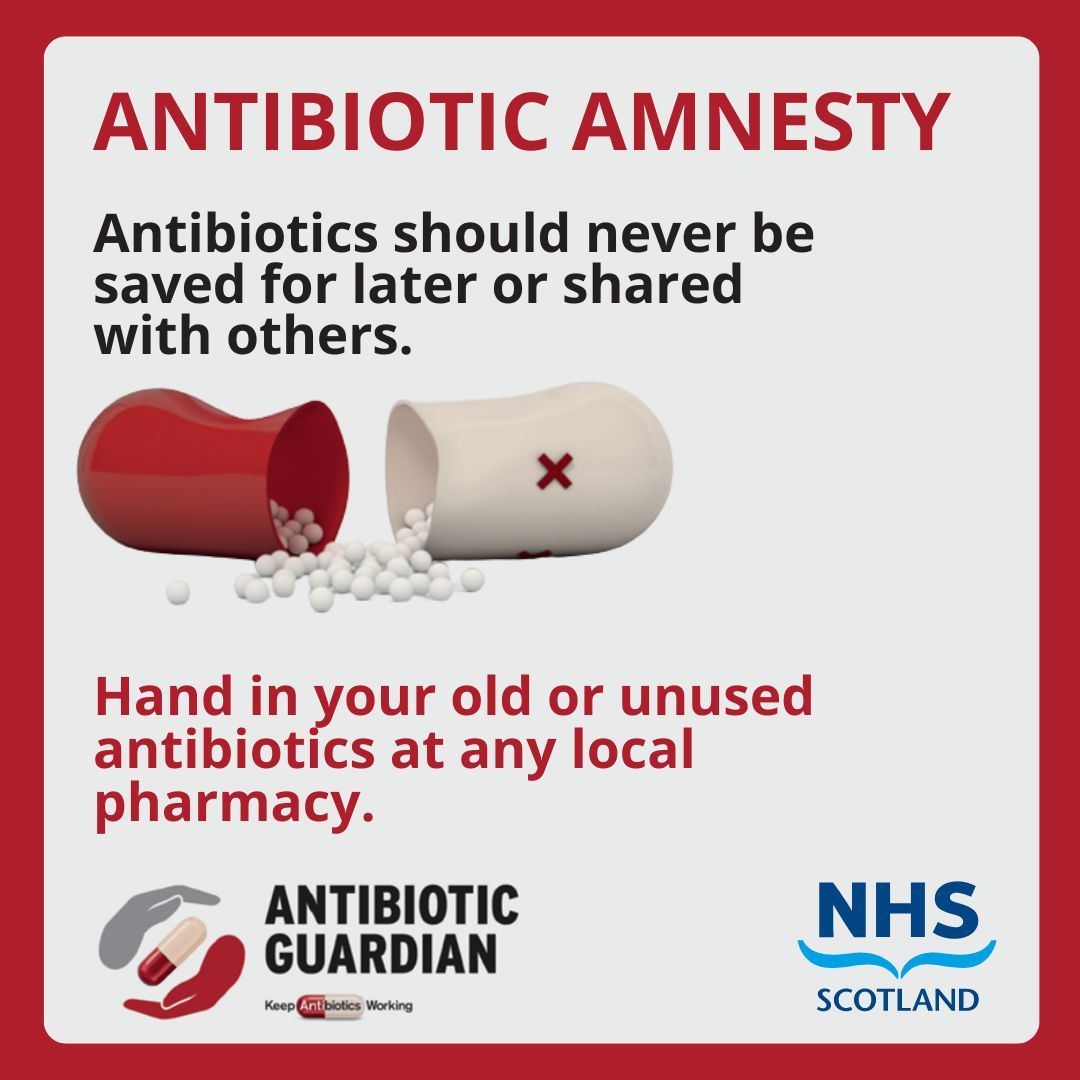
Never share antibiotics with others.
Never dispose of unused medications in toilets, sinks, or bins. Return any unused medications to the pharmacy for safe and sustainable disposal.
The Scottish Government and NHS Scotland have produced a toolkit to support this messaging. This toolkit provides resources, useful information, and support to encourage safe and sustainable use of antibiotics and can be used as a starting point to develop activities and local efforts to promote action against AMR, along with useful links where you can learn more about AMR and the threat it poses.
Over the course of World AMR Awareness Week, NHS Boards and other partners are planning a range of local activities and social media messaging. We hope that you can engage with this urgent agenda and make use of the opportunities to take part in awareness-raising work throughout the week. By working together to promote this messaging and taking positive and proactive action to be mindful of the use of antimicrobials, we can minimise the threat of AMR and ensure that they remain effective in the future.
Food Standards Scotland (FSS) and the Food Standards Agency (FSA) have confirmed that all necessary food safety measures have been put in place and affected products removed from sale following an investigation into mustard products being contaminated with peanuts.
As a result, they have lifted their precautionary advice to people with a peanut allergy to avoid eating foods that contain or may contain mustard, mustard powder, mustard seeds or mustard flour both in the home and when eating out as these products are now safe to eat.
FSS and the FSA are assured that actions taken in response to the initial food safety concerns have been addressed, following extensive investigations by Leicester City Council, the enforcing Local Authority, and FGS Ingredients Limited, supported by FSS and the FSA, as well as checks on supply chains by retailers and manufacturers. In addition, FSS and the FSA are assured that there is no increased risk to consumers from other mustard products, that have not been supplied by FGS.
FSS and the FSA continue to advise food manufacturers and food businesses to review their food supply systems and remove any products that are affected by precautionary recalls from FGS Ingredients Limited.
It is important that people with a peanut allergy should continue to avoid products that are listed in the allergy alert. Consumers and businesses are urged to check whether they still have any of the affected products listed and if so, they should follow the advice in the alerts.
Some mustard-based products will now have a precautionary allergen label (PAL) and consumers with a peanut allergy should check whether products they might have previously purchased carry these labels.
We use cookies to ensure that we give you the best experience on our website. If you continue to use this site we will assume that you are happy with it.