
COVID- Diary – Lorna Ross

Lorna Ross, Food & Safety Support Officer at Aberdeenshire Council discusses how taking the plunge to online learning has resulted in a positive change and how learning in person may be a thing of the past. 

1. Describe you work before the pandemic? 

Life before COVID-19 was busy, 4 or 5 courses a week including weekends and Saturdays for some clients. I was presenting nearly the full range of REHIS courses from Food Hygiene, Health & Safety, Infection Control and my personal favourite HACCP, at all levels from Elementary to Advanced.  Each day was different as my area covered the whole of Aberdeenshire from Laurencekirk in the South to Portsoy in the North and everywhere in between.  On some occasions I even got to break out of the ‘Shire to as far away as Elgin or even once to the Shetland Isles!  I loved meeting new people, seeing their enthusiasm for the topic grow and watch new friendships being formed in the room.  Having delegates successfully pass their end of course exam was the cherry on the cake, but the learning journey was far more important to me, as it was during that journey that new best practice would really be embedded.  I wasn’t stuck in an office all the time so I could honestly say that for each and every day I loved my job.

2. What have you been doing since the pandemic started? 

Everything was rosy in the garden then COVID-19 came along! At first I thought it would be a wee short lived problem so cancelled the courses for the coming month, then extended it to 2 months until finally admitting that COVID-19 was winning, so all future face to face courses were cancelled.  I don’t mind admitting that it was a really scary time, as effectively my own job was now cancelled, so what on earth do I do now!  A quick phone call and discussion with Jackie McCabe then quickly put me on the new track, as REHIS had approved the use of virtual video exams.  Now that was something I could work with, if I can’t train people in a meeting room, could I train them in their living room? After much trial and error, sleepless nights and a bit of swearing I cobbled together an online course that could be done from any device then concluding with a video exam and Microsoft Forms.  It is by no means perfect but hey Rome wasn’t built in a day, and I do work for the Local Authority so nothing happens that fast!!

3. What are/were the challenges? 

Where do I start with the challenges!? For anyone who doesn’t know, Aberdeenshire is just under 2500 square miles of hills, valleys, trees, small villages, and a few larger towns not an area renowned for its superfast broadband!  The lack of viable broadband coupled with a variety of electronic devices being used in peoples own homes made for intermittent meetings, breaks in communication and more than its fair share of ‘try logging out and back in again’ moments.  For a lot of my candidates this would be their first venture into online training, so the fear of the unknown added to the fear of the course material itself.  Getting access to the best computer packages was another hurdle that I haven’t quite overcome yet, as being a local authority closed a lot of doors as we are not seen as a centre of learning. 

More personal challenges also had to be overcome.  I had gone from meeting up to 100 new people each week to working at home with a farmer husband who funnily enough could not work from home, and a wee border terrier who is not much of a conservationist! Anyone who knows me, will know I am not best known for being quiet and not speaking, so this was hard.  Thanks goodness for colleagues who felt in the same boat, so lots of venting could be had over Skype!! And here I am more than a year sitting in the same spot in my house, still powering on.

4. Do you think any of these changes will last beyond the pandemic period? 

To be honest I think the old way of training and learning is a thing of the past.  Having 20-25 complete strangers in a room at the same time for up to 8 hours will not be happening anytime soon if at all, so we need to brave a new future.  I was not a huge fan of the thought of blended learning at first, but after I pulled up my big girl pants I realised that if I could do it well, it would work.   I think the awareness of supporting delegates while they are training is more important than ever, and not just knowledge support, but listening to them, hearing their concerns and being flexible.  I have had to reschedule exams last minute, due to family emergencies, to unforeseen work commitments and even once because a tractor and trailer of cattle had broken down!  Planning courses months in advance and hoping people can book on, will be replaced by more tailored training reacting to the delegate needs rather than when I fancy training in Stonehaven!  Change can be good if done in the right way, so bring it on.
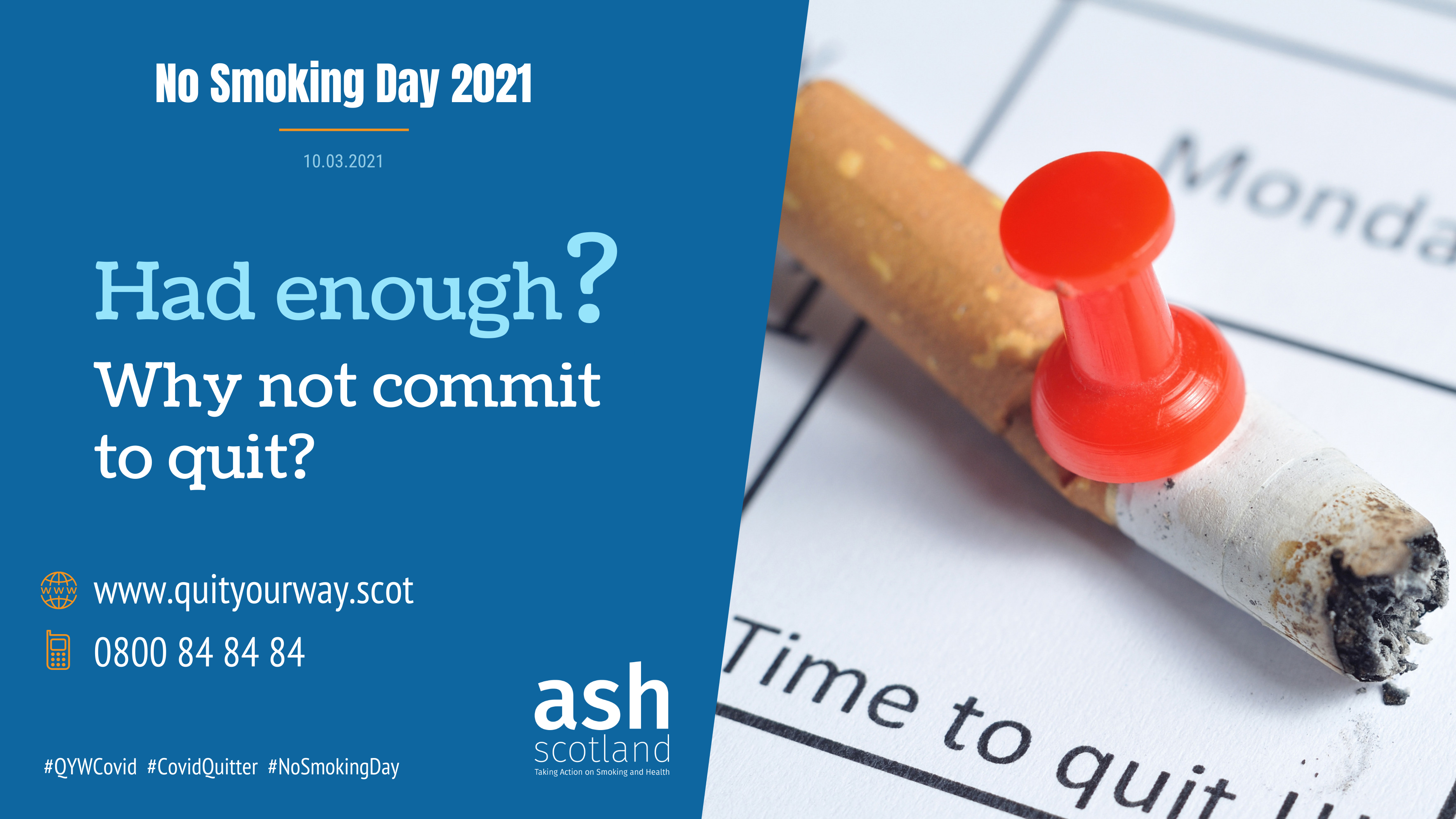
No Smoking Day 2021

This Wednesday, 10 March is No Smoking Day.  ASH Scotland is celebrating the day by encouraging people to quit smoking by sharing the stories of people who have successfully stopped smoking during lockdown. 

This year has been tough for everyone and people are coping as best they can.  For some, that means smoking more than they normally would.  In fact, a recent Scottish Government survey found that more than a third (36%) of people who smoke report smoking more during lockdown – with just 8% saying they are smoking less.

We know that quitting smoking is one of the best things you can do for your physical health and it also improves your mental wellbeing. Trying to quit smoking at this time may feel overwhelming, but help and support to stop smoking is available through Quit Your Way Scotland, even during lockdown.

Want to help spread the word about No Smoking Day?  Please follow @ASHScotland on Twitter and share our content on 10 March.  If you or someone you know is thinking about stopping smoking, Quit Your Way Scotland can provide all the help and support you need to get started on your quit journey. 

Asymptomatic testing being rolled out across the country

Asymptomatic testing sites are being rolled out across the country following successfully trial in Johnstone in December.

Community testing in areas with high coronavirus (COVID-19) prevalence are a way of identifying positive cases in communities and breaking chains of transmission.

The sites are being delivered by Local Authorities in partnership with NHS Boards and are being funded by the Scottish Government. Environmental Health departments within Local Authorities have had large amount on input to the delivery of these sites. 

Fife has set up a testing site in Cowdenbeath with four more sites in different areas across Fife opening in the coming weeks. Meanwhile, two sites in Glasgow are also opening up 1 March and are being staffed by the Armed forces. Another site in East Renfrewshire in Barrhead will also be opening on 1 March. 

Further proposals for Ayrshire & Arran, Dumfries & Galloway, Greater Glasgow & Clyde, and Grampian have been agreed, and discussions are underway with a number of other boards and local authorities for agreement.

The sites will provide lateral flow testing, followed by a confirmatory PCR test if the first result is positive. 

Community testing has continued in the meantime with Mobile Test Units deployed since 18 January to provide testing for people with and without symptoms in the following communities: Maybole, Grangemouth, Langholm, West Linton, Sauchie, Denny, and Hawick. Data on the number of people tested and positivity rates at these sites will be published by Public Health Scotland.

In addition, waste-water tests and the most up-to-date data will be used to identify communities where asymptomatic testing is needed. Additional mobile testing will also be under-taken as a rapid response to any outbreaks.

Public Health Minister Mairi Gougeon said: "Targeted testing in this way will help us find and isolate more cases, by targeting resources with communities where there is high prevalence, helping us to identify more cases of the virus and giving us all a better chance of stopping it from spreading.

"However, a test only tells us if we are positive at the point in time that we are being tested.  It does not mean that we can stop following all of the rules and guidelines which are in place to protect all of us. Testing is only one layer of protection against this virus – all others, including vaccination and the FACTS guidance work to greatest effect when they work together, so it is essential people continue to follow the restrictions currently in place to suppress COVID to the lowest possible level in Scotland.

"This expansion has been made possible as our testing capacity has increased but it could not have happened without the support of our local partners, and everyone involved in Scotland's testing programme, from diagnostic staff to sample takers, and I want to pay tribute to each and every one of you as we continue to work to suppress this virus together."

Dr Linda de Caestecker, Public Health Director for NHS Greater Glasgow and Clyde, said: "We know that COVID-19 is often spread by people who don't have symptoms or they are so mild they do not recognise they have the infection. 

"Asymptomatic testing enables identification of infection so that people are not spreading the infection to their families, work colleagues or the wider community as they go shopping or exercising. This has the potential to reduce spread overall. That means we will be more likely to be able to reduce restrictions more quickly.  Asymptomatic testing will also help us learn about the rate of infection in people not showing signs of the virus.  Please come forward for testing to help to reduce transmission of the virus in this area. The centres will also give advice about support for isolation for people with a positive test.

"As we're asking people with no symptoms to come forward, we are highlighting the fact that it is possible to have the virus and feel absolutely fine or have vague and mild symptoms- which is why it is so important that people continue to maintain physical distancing, and use face coverings and hand-washing as additional measures of protection against the virus."


Scotland’s Carbon Footprint: 1998-2017

Scotland's Chief Statistician has published Scotland’s Carbon Footprint: 1998-2017. This publication provides estimates of Scotland’s greenhouse gas emissions on a consumption basis; that is emissions that are associated with the spending of Scottish residents on goods and services, wherever in the world these emissions arise, together with emissions directly generated by Scottish households.

Key points:

·       Between 2016 and 2017, Scotland’s carbon footprint (emissions from all greenhouse gases) decreased by 3.5 per cent to a record low of 70.7 million tonnes of carbon dioxide equivalent (MtCO2e).

·       Between 1998 and 2017, Scotland’s carbon footprint fell by 21.1 per cent, from 89.6 MtCO2e in 1998 to 70.7 MtCO2e in 2017.

·       Scotland’s carbon footprint rose from 1999 onwards to a peak of 101.1 MtCO2e in 2007 before falling sharply in the following years (coinciding with the recession) and has generally fallen gradually in more recent years. The overall reduction between the 2007 peak and 2017 is 30.0 per cent.

You can read the full statistical publication.

Avian Influenza Case

Bird keepers in Scotland are reminded to maximise biosecurity and keep their flocks housed after avian influenza (H5N1) was confirmed in a flock of approximately 14,000 mixed gamebirds on a gamebird rearing premises in Leven, Glenrothes.

Laboratory results of samples taken from the flock have identified the strain as highly pathogenic in poultry. In order to limit the further spread of disease, appropriate restrictions have been imposed on the premises.

A Protection Zone (PZ) of 3 km and a Surveillance Zone (SZ) of 10 km have now been put in place around the infected premises to limit the risk of spread of the disease. Within these zones a range of controls are in place, including restrictions on the movement of poultry, carcasses, eggs, used poultry litter and manure. Legislation for the H5N1 strain require a Restricted Zone (RZ) to also be declared. However, this RZ will also be 10 km and will have the same extent as the PZ and SZ, with no additional measures.

Public health advice is that the risk to human health from the virus is very low and food standards bodies advise that avian influenzas pose a very low food safety risk for UK consumers, and it does not affect the consumption of poultry products including eggs.

Producers and bird keepers are reminded to comply with the order to house birds that came in to effect on the 14 December 2020, or ensure they are kept separate from wild birds and follow biosecurity procedures.

Expansion of Testing

Access to testing to find cases and interrupt transmission already taking place in Scotland is being stepped up.

Routine testing of healthcare workers has been expanded to cover patient-facing primary care workers such as GPs, dentists, optometrists and pharmacists, as well as testing for all patient-facing staff who work in hospices.

From later this month, regular testing will be offered to support the return to schools and nurseries. Senior phase secondary school students, and all staff in primary, secondary and special schools, including school-based ELC staff, will be able to benefit from routine at-home testing two times a week

Certain workplaces where the risk of transmission is greater and which provide essential or critical services, such as those within the food processing and distribution sectors and staff within emergency service control rooms, will also be supported to introduce routine workforce testing

Targeted community testing will continue to be expanded – so that testing is available to people locally, regardless of whether or not they have symptoms

In addition,  testing is also be offered to all close contacts of people who have tested positive for COVID-enabling Test and Protect teams to identify their contacts and track, and break further, chains of transmission.

HSE updates guidance on disinfecting premises during the coronavirus pandemic

The Health and Safety Executive’s guidance on disinfecting premises during the coronavirus pandemic has been updated to include joint advice on risks to health that can be created by using walk-through spraying or misting systems.

HSE and public health bodies in England, Wales and Scotland have agreed joint advice on the risks to health from walk-through disinfecting systems for dutyholders considering using them to reduce transmission of coronavirus. 

Spraying people with disinfectants is not recommended under any circumstances (including in a tunnel, cabinet, or chamber). The World Health Organisation has also confirmed that it could be harmful and does not reduce the spread of the virus. This is because transmission is usually through droplets or contact, so the effectiveness of these systems is likely to be minimal.

There is more information from the government’s Scientific Advisory Group for Emergencies (SAGE) on potential health risks from whole-body walk-through systems.

The updated page on HSE’s site also has helpful advice on:

  • cleaning premises using fog, mist or UV treatment
  • the law on disinfectants
  • only using HSE-authorised products in the UK
  • supply and manufacture of disinfectants

Agencies reiterating advice on the cooking of frozen raw breaded chicken products following link to rising cases of Salmonella

Food Standards Scotland (FSS), Public Health Scotland (PHS), the Food Standards Agency (FSA) and Public Health England (PHE) have issued a further warning on the handling and cooking of frozen raw breaded chicken products such as nuggets, goujons, dippers, poppers and kievs.

The move comes as the organisations are involved in a multi-agency investigation into a suspected rise in cases over the past year of salmonella linked to processed chicken products and follows the issue of a further two product recalls on Thursday (February 18) for products linked to the ongoing UK outbreak of Salmonella Enteritidis (a food poisoning bug).

An investigation is on-going into two particular strains of salmonella linked to frozen raw breaded chicken products. Health agencies on both sides of the Border have recorded an increase in cases linked to these strains of Salmonella throughout 2020 and control measures were put in place including the issue of precautionary advice to consumers by both FSS and the FSA in October.

Given the long shelf life of these products and the additional recalls, both FSS and the FSA are reminding the public again about the importance of thorough cooking and safe handling of frozen breaded chicken products.

Since January 2020, there have been 480 cases of Salmonellosis across the UK, caused by two strains of Salmonella Enteritidis linked to frozen, raw, breaded chicken products – 42 of which have been confirmed in Scotland.

FSS advice is that people should always follow good hygiene practices to help reduce the risk of food poisoning when preparing raw chicken items including nuggets, goujons, dippers, poppers and kievs.

FSS Deputy Chief Executive, Ian McWatt, said:

“While the numbers of cases in Scotland related to this outbreak remain relatively low, it is important to remind people that they should always check and follow the cooking instructions on food packaging, as different brands of the same product may have different preparation processes. 

“Preparing food at the right temperature and for the correct length of time will generally ensure that any harmful bacteria are killed, but people should also take care when storing and handling these types of frozen breaded chicken products to help reduce the risk of food poisoning. Ideally, these products need to be handled as other types of raw chicken”

The following recalls are linked to this Salmonella outbreak:

·       SFC recalls SFC Chicken products because of the presence of Salmonella

·       Vestey Foods recalls Chick Inn 32 Jumbo Chicken Nuggets because of the presence of Salmonella

·       Aldi recalls Roosters Southern Fried Poppin’ Chicken and Roosters Breaded Poppin' Chicken because of the possible presence of salmonella

·       Iceland recalls Chip Shop Curry Chicken Breast Toppers and Southern Fried Chicken Popsters because of the presence of salmonella

·       Aldi extends its recall of Roosters Southern Fried Poppin’ Chicken and Roosters Breaded Poppin' Chicken because of the possible presence of salmonella

·       Lidl GB recalls Red Hen Breaded Chicken Nuggets and Red Hen Southern Fried Chicken Pops because of contamination with salmonella

Improved allergen labelling becomes law to protect consumers in Scotland

New legislation, which will require food businesses in Scotland to include the product name and full ingredients, including allergen information on pre-packed for direct sale (PPDS) foods was been laid in Parliament on 11 February 2021.

The new legislation will improve information about allergens and other ingredients in food packed in advance, mainly at the same place from which it’s sold, before being offered to consumers.

Examples of PPDS foods include sandwiches placed into packaging by the food business and sold from the same premises, wrapped deli counter goods such as cheese and meats, and boxed salads placed on a refrigerated shelf prior to sale.

This new requirement follows wide consultation, including engaging with business and enforcement stakeholders, and consumers on improving allergen information, to help prevent further food allergy deaths in the out of home environment.

The new law will offer increased protection and confidence for consumers living with a food allergy or intolerance in the food they buy out and about. On pack information will include the 14 ‘most common’ allergens specifically listed in food information law, as well as other ingredients which can trigger reactions.

The new law is intended to come into force on 1 October 2021 to align with the rest of the UK.

These changes are in line with those being made for England, Northern Ireland and Wales as part of a consistent approach for protecting consumers across the UK.

Quarantine hotels

All arrivals to Scotland from outside the Common Travel Area must book and pay for managed isolation in quarantine hotels to help protect against the importation of Coronavirus (COVID-19) from 15 February.

Six hotels close to Aberdeen, Edinburgh and Glasgow airports with a combined capacity of 1,300 rooms will be used to implement the quarantine at a cost of £1,750 per individual traveller. Final costs for those not travelling alone are currently being worked through, as well as the details for a Managed Isolation Welfare Fund which will be launched for those who cannot afford the charge. 

All arrivals must quarantine for at least ten days and will be tested twice for the virus – once on day two and once on day eight after arrival. 

Existing travel exemptions will be strengthened, including limiting overseas training for elite sportspeople to athletes and coaches preparing for the Olympics and Paralympics.

A small number of arrivals will not be required to isolate, such as those involved in essential supply chains for goods coming into Scotland.

The Scottish Government will continue to engage with airports and discussions to secure a four nations approach to contracting the security, transport and accommodation services required are already under way.

As regulations to support the introduction of managed isolation are developed a range of offences and penalties to help ensure compliance will be considered.

It is still the case that all non-essential international travel is not permitted.

In a statement to Parliament the Transport Secretary urged the UK Government to match the comprehensive approach being taken by the Scottish Government.

Coronavirus (COVID-19): international travel and quarantine – gov.scot (www.gov.scot)


Close contacts to be offered COVID-19 testing

People who have been identified as a close contact of someone who has tested positive for Covid-19 are now being asked to get tested.

The Scottish Government announced that the measure is designed to find asymptomatic coronavirus cases that would otherwise go undetected, as close contacts are at higher risk than the wider population, given their exposure to somebody with COVID-19.

Previously, outbreak Incident Management Teams (IMTs) have had the ability to order testing of close contacts on a case-by-case basis, in line with local assessment of clinical risk.

Now everyone who has been identified as a close contact via the Protect Scotland app, or through manual contact tracing, will be provided with instructions on how to book a PCR test.

The approach does not replace self-isolation in any way, and close contacts who test negative will still have to complete 10 days of self-isolation, as the virus’ incubation period means the risk of developing COVID-19 is only significantly reduced 10 days after exposure.

This means anyone leaving self-isolation early could still inadvertently infect others if they become positive at a later date.

Close contacts who test positive will be asked to self-isolate for a further 10 days from the time of their test result, to ensure they are no longer infectious when they leave self-isolation.

Scottish Health Survey – telephone survey – August/September 2020

As a study of public health, the Scottish Health Survey (SHeS) plays an important role in assessing health outcomes and challenges in Scotland. With aims to reduce health inequalities and improve Scotland’s life expectancy status, currently one of the lowest in Western Europe (including in the UK), improving the health and wellbeing of Scotland’s population continues to be a key policy focus both at local and national level. 

Read the report here.